Coffee Shop Reflections
Why I work best among strangers in a coffee shop, and whether the Paris café of Hemingway and the existentialists is a tradition or a fantasy sold by the cup.
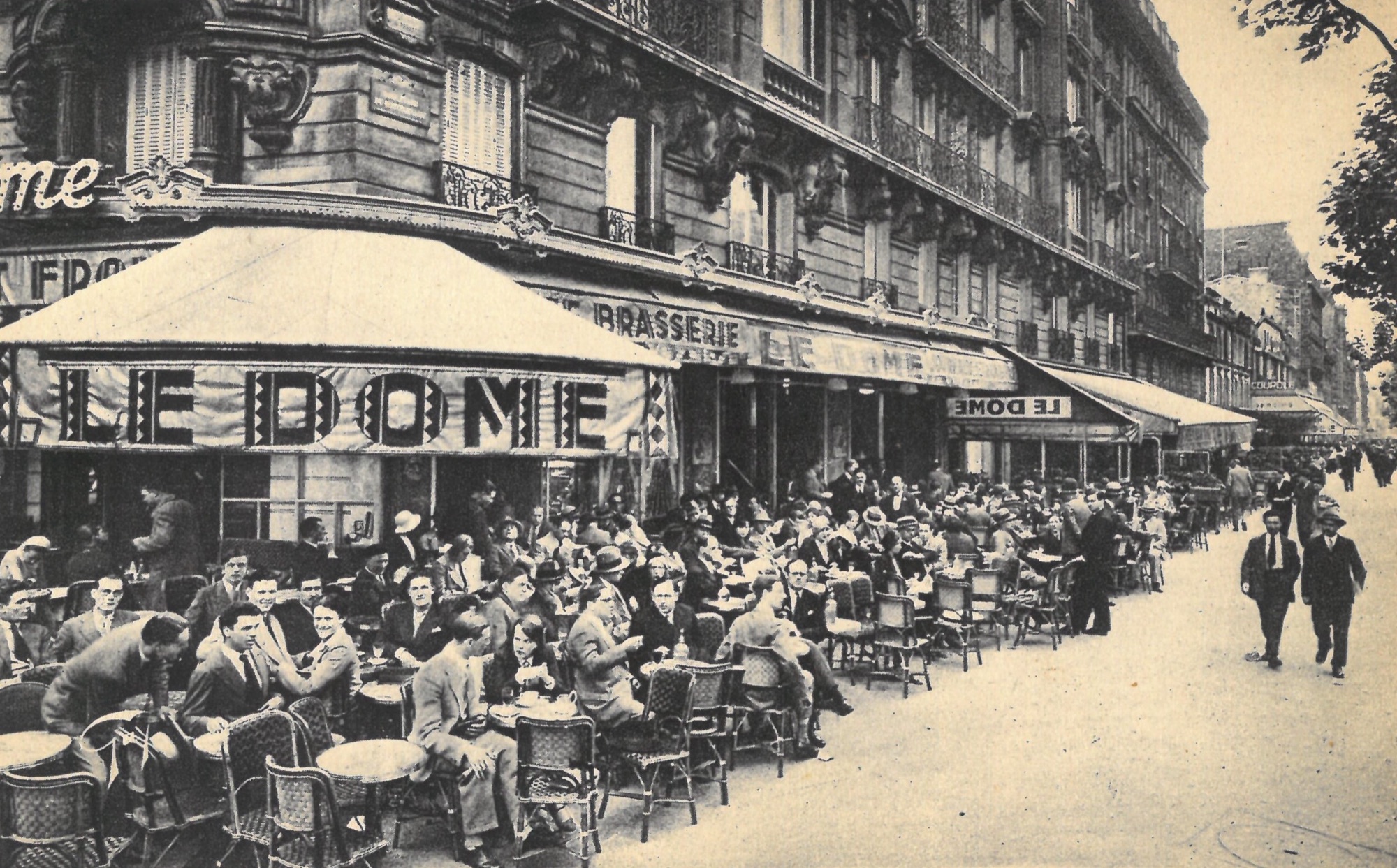
Crowds came to form a shield against their own dying.
I have always liked studying in coffee shops, and for a long time I could not say why. The smell of espresso and steamed milk brings back good memories, but I can make myself an iced latte at home with very little effort. Financially, a coffee shop is one of the worst decisions I make in a week, since the drink costs several times what it would at home, and the bitterness of coffee does nothing for the taste for sweetness we are born with. I keep going back anyway.
Economists have an explanation for at least part of this. In 1998 Joseph Pine and James Gilmore followed the price of coffee up a ladder. The beans in a cup are worth a cent or two; roasted, ground and packaged for a grocery shelf, the same cup costs between five and twenty-five cents; brewed and served at a diner, fifty cents to a dollar; and served at an espresso bar such as Starbucks, where ordering and drinking the cup is a small piece of theater, two to five dollars.Pine and Gilmore, “Welcome to the Experience Economy,” Harvard Business Review, July–August 1998. The prices are in 1998 dollars. At the top of the ladder, they argued, the customer is no longer paying for coffee but for an experience, and they called the economy built on such purchases the experience economy. They were right about me. What I pay for in a coffee shop is not the coffee. But “an experience” only names the product, and it does not say what the experience is or why it should help me work.
The precedent for my habit is also flattering, which makes me suspicious of it. The cafés of twentieth-century Paris were where the French existentialists wrote during and after the Second World War, and where Ernest Hemingway, of the generation Gertrude Stein called lost, wrote his first stories. It is tempting to think that I am continuing a tradition when I open a notebook at a café table. Later in this essay I will ask whether that tradition is real, or a romance that is now sold by the cup, which is the more uncomfortable question.
The question first took shape on a long flight from the Northern to the Southern Hemisphere, while I was reading a book introducing the psychology of Alfred Adler. Somewhere over the ocean I copied down a line I took to be Adler’s, that crowds and cities shield us from the sense of mortality, and it seemed to explain why I prefer crowded places for what is now called deep work. I have since been unable to find that line in Adler. The closest version I know of is the one at the top of this essay, from Don DeLillo’s novel White Noise. Adler’s own term for what I was looking for is Gemeinschaftsgefühl, usually translated as social interest or community feeling, the sense of belonging to a larger whole, which he considered a measure of psychological health. Wherever the line came from, it started the self-examination that follows, and the place to begin is with what I actually look for in a coffee shop.
Criteria for a Great Coffee Place
I have five conditions for a good place to study or work. The first is practical: the place must have a clean restroom and somewhere to charge a laptop, which in our time is not negotiable. The second is that it should have some aesthetic appeal. This is the trickiest of the five, since your taste in cafés may well differ from mine, and I will come back to it, because it turns out to be where the trouble lies.
The third condition is the most personal. The place must not be frequented by people I know, which in practice means a café some distance from where I live. Not everyone has this requirement, and that is exactly why it deserves examination. The fourth is that the shop should be moderately crowded, and at the very least it must have staff. There is no reason in principle that a coffee shop could not be run entirely by machines, and I would not work in one.
The last condition is that the coffee and the pastries be decent. I am not a connoisseur of either, and it is telling that quality comes last on my list. The taste only has to avoid spoiling the stay, since we are animals heavily influenced by our senses, smell and taste above all. Because I rank the product last, a coffee shop is for me more a cultural place than a commercial one, or, as I put it when I first wrote this essay, more cultural than capital. I also promised then to return to the question of Starbucks. I will keep that promise at the end, once the phrase “more cultural than capital” has taken the criticism it deserves.
Comfort, but with Distance
The general atmosphere of a coffee shop is a cozy one: a warm place in winter, a shelter from the rain, the smell of beans and some jazz in the air. It can feel almost like home, but that is not why I go, since if I wanted to feel at home I would stay there. A café does offer comfort, but by my third condition its customers are strangers, and I am not trying to make it feel like home. The staff stays more or less the same, but I rarely go for the staff. The visit is a personal undertaking, and the best description I have found for what it offers is comfort, but with distance.
The distance is, first of all, the fact that the people around me are strangers. Camus could make that sound dreadful, a stranger among strangers in a strange place. Yet a coffee shop produces the opposite feeling, since you are surrounded by strangers and do not feel isolated. That combination makes a café a good place for people who enjoy the healthier kind of solitude, because it keeps the feeling of isolation at bay without asking for anything in return.
We are beings that are both communal and individual. Each of us experiences the world from our own perspective, and no matter how hard we try, no one else can occupy exactly that perspective, which makes us, in one sense, fundamentally alone. This fact does not and should not dictate how we live, however, because we live by beliefs as much as by facts, and almost by instinct we believe that we belong to some larger community, which keeps us from being overwhelmed by our aloneness. The difficulty is that close involvement in a community is physically and emotionally taxing, especially for thinkers and people who enjoy solitude, who may well be the same people. What a good coffee shop gives me is a sense of community together with the composure of an individual who is not bound by the surroundings. My fourth condition, a moderate crowd, supplies the first half of that, and my third, being a stranger, supplies the second.
To be an individual among a community is a wonderful feeling.
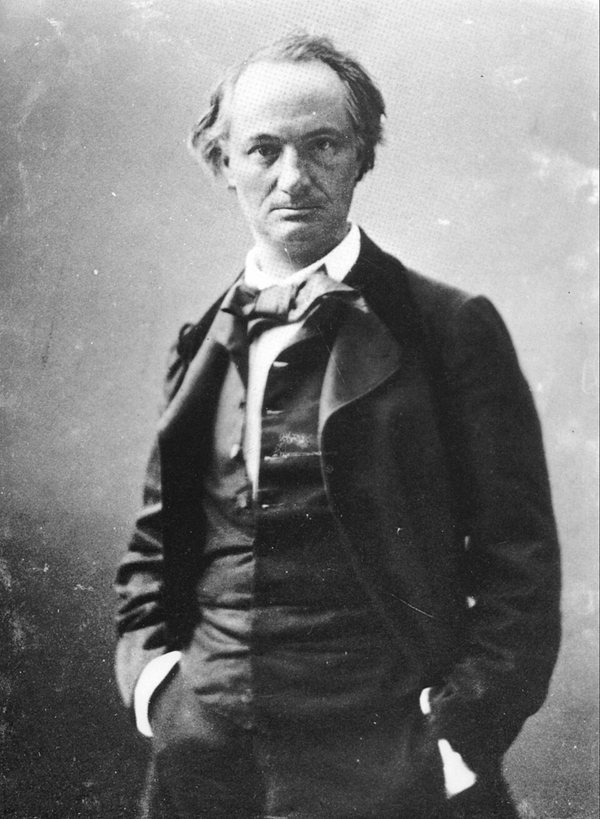
None of this was new when I noticed it. Charles Baudelaire described the same pleasure in The Painter of Modern Life (1863), in his portrait of the flâneur, the observer who wanders the Paris crowd: “To be absent from home and yet feel oneself everywhere at home; to view the world, to be at the heart of the world, and yet hidden from the world.”Translated by A. S. Kline. Older translations render it “to be away from home and yet to feel oneself everywhere at home.” Baudelaire introduces the artist he is writing about with a scene borrowed from Edgar Allan Poe’s story “The Man of the Crowd” (1840), in which a convalescent sits behind the window of a London coffee-house and watches the crowd go by with pleasure. Baudelaire’s model of the modern observer, in other words, is a man sitting in a café.
Sociologists later described how this arrangement works. Georg Simmel argued in “The Metropolis and Mental Life” (1903) that city dwellers protect themselves from an overwhelming flood of impressions by cultivating a reserve toward the people around them, and that this reserve is also the condition of a personal freedom that small towns, where everyone knows everyone, do not allow. Erving Goffman gave the everyday mechanism a name in Behavior in Public Places (1963). He called it civil inattention: strangers give one another just enough visual notice to acknowledge each other’s presence and then withdraw their attention, signaling that neither intends to intrude. A café full of strangers is a room in which everyone is practicing civil inattention at once, and that is what lets me be among people without being with them.
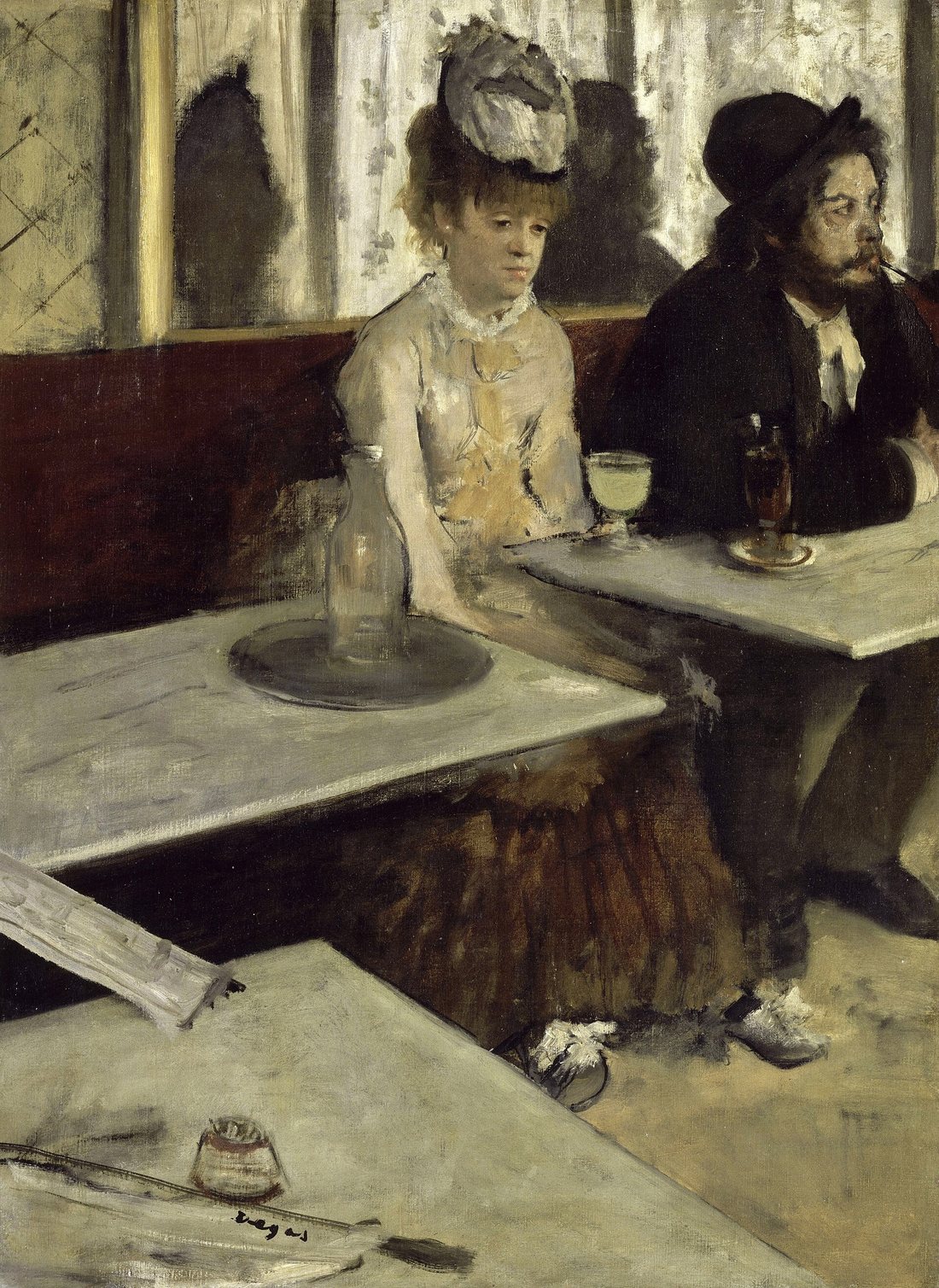
Simmel also saw the other side of this freedom. The same reserve that protects the city dweller can leave a person lonelier in a crowd than anywhere else. Degas painted that version of the café in 1875 and 1876. In In a Café, a man and a woman sit side by side at a café table, each looking somewhere else, close enough to touch and entirely alone. Distance without the comfort is just loneliness, and the line between the two is thinner than I like to admit. What keeps my afternoons on the right side of it, I think, is the subject of the next section.
It is also worth saying what my kind of café is not. In The Great Good Place (1989) the sociologist Ray Oldenburg described what he called third places, the cafés, pubs and barbershops outside home and work where a community gathers informally. For Oldenburg the heart of such a place is its regulars, and its main activity is conversation. By that definition the cafés I like are not third places at all, since I go where there are no regulars I know, and I go to work rather than to talk. Oldenburg’s third place is somewhere to be with others. Mine is somewhere to be alone in the presence of others, which is a different need, and probably a more modern one.
A Space for Creative Work
Being a stranger among strangers is not enough by itself. In a strip mall I am also a stranger among strangers, and the feeling I described above does not appear, so what we do in a coffee shop must differ from what we do at a mall. In a café, at least in Los Angeles, people sip coffee and read, write or work on something of their own. At a mall we are shoppers, and purely consumers. Reading and working are what produce the sense of being an individual, independent of the surrounding community for as long as the work lasts.
To get the most out of a coffee shop, you have to do creative work there.
This is why my first two conditions matter as well. A café must have the facilities to support work over a long stretch, since creative work is never short, and its aesthetic appeal can give the mind a boost. My fourth condition has some evidence behind it too. In a set of five experiments, Ravi Mehta, Rui Zhu and Amar Cheema found that a moderate level of ambient noise, around 70 decibels, roughly the hum of a busy café, improved people’s performance on creative tasks compared with a quiet 50 decibels, while a loud 85 decibels made it worse.Mehta, Zhu and Cheema, “Is Noise Always Bad? Exploring the Effects of Ambient Noise on Creative Cognition,” Journal of Consumer Research 39(4), 2012. Their explanation was that moderate noise makes thinking slightly harder, which pushes people toward more abstract processing. It is one line of research and I would not build much on it, but it agrees with my experience that a silent room is not always the best place to think.
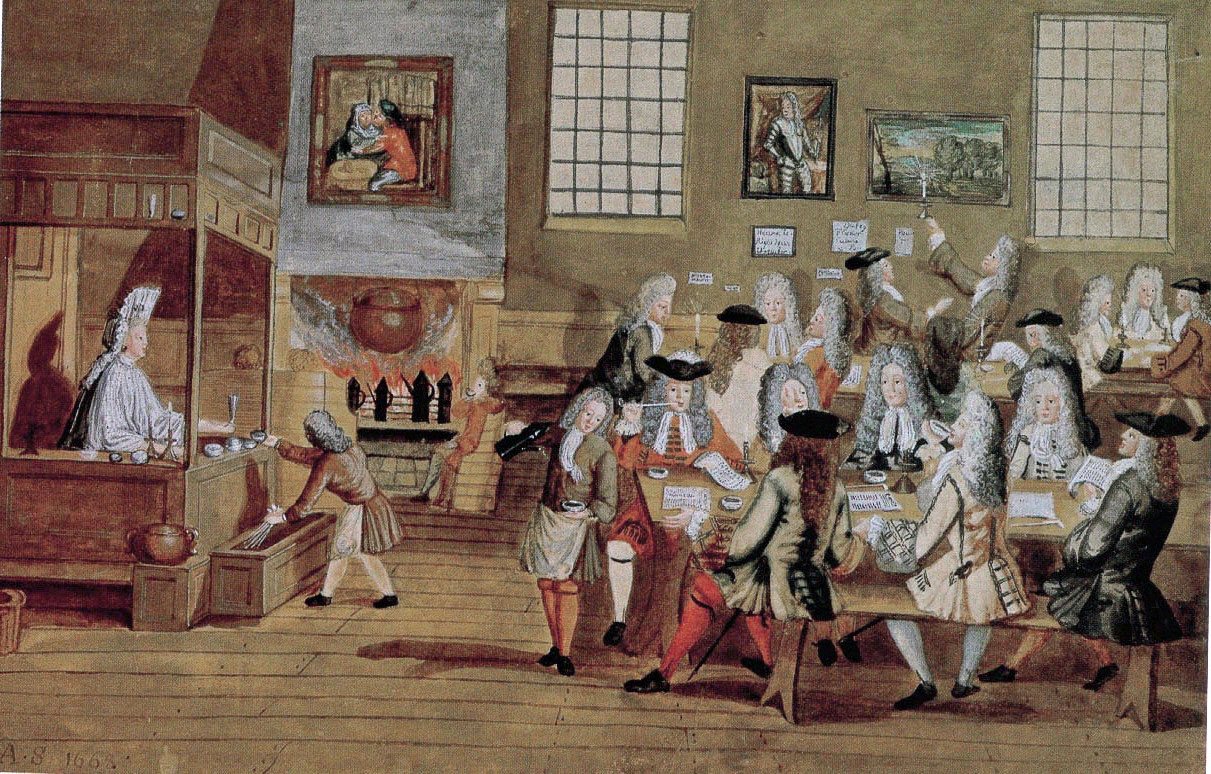

The distinction between the café and the mall is older than it looks. In The Structural Transformation of the Public Sphere (1962), Jürgen Habermas traced the birth of what he called the public sphere to the coffee-houses of late seventeenth- and eighteenth-century London, together with the salons of Paris and the reading societies of Germany. In these rooms, sometimes called penny universities after the price of a cup, private people met to read the new periodicals and argue about literature and then about politics, setting aside differences of rank for the length of the argument. Habermas’s story then turns into one of decline: with mass media and advertising, he argued, the public went from debating culture to consuming it, in his phrase “from a culture-debating to a culture-consuming public.” Historians have since shown that he idealized the coffee-house, which excluded most women and the poor, and Habermas himself later conceded that he had overstated how rational the early public sphere was. But his distinction is the one I was groping for with the mall. The same kind of room can hold a public that thinks or a public that consumes, and the difference lies in what people do there. Mine is a smaller and more private version, since I go to work rather than to argue, but the line between the café and the mall runs where Habermas drew it.
Tradition, Romance or Fetish?
This brings me to the question that has bothered me since I first wrote this essay. When I sit in a café with a notebook, I am aware, at least dimly, of the people who did this before me: Sartre and Beauvoir at the Café de Flore, Hemingway at the Closerie des Lilas, the crowd on the terrace of the Dôme at the top of this page. Is that awareness a connection to a real tradition, or is it a romance, or worse, a cultural fetish, in which a set of objects such as the small round table, the espresso and the notebook is treated as though it could deliver what only the work can?
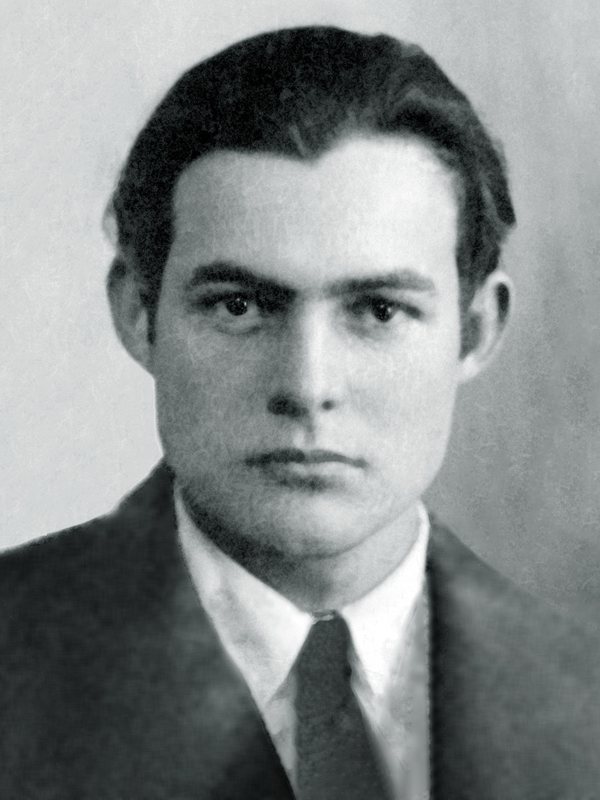
The tradition looks less glamorous up close. Hemingway’s account of writing in Paris cafés is A Moveable Feast, and its first chapter, “A Good Café on the Place St.-Michel,” describes a café he liked on a cold, wet day because it was “warm and clean and friendly,” which is very nearly my first condition. The book is also not quite a record of what happened. Hemingway wrote it between 1957 and 1960, more than thirty years after the years it describes, working partly from notebooks he had recovered from a trunk at the Ritz in Paris. It was published in 1964, three years after his death, and its preface says that “if the reader prefers, this book may be regarded as fiction.” The best-known picture of a writer in a Paris café is therefore a memory, written down thirty years later by a novelist, and it should be read as one.
The existentialists’ café has a similar history. Sartre and Beauvoir worked at the Café de Flore during the German occupation in large part because it was heated: fuel was scarce, and the Flore kept a stove going.Beauvoir describes these years in her memoir The Prime of Life (1960). The details here come from secondary accounts of the Flore’s history. Sartre is said to have written much of Being and Nothingness there. Then in October 1945 Sartre gave his lecture “Existentialism Is a Humanism” to a crowd far larger than the hall could hold, existentialism became a fashion, and the Flore became a place people went to look at existentialists. By several accounts, before the year was out the two of them had moved their working hours to the basement bar of the Hôtel Pont-Royal to get away from the attention. The legend of the existentialist café, in other words, drove the existentialists out of it.
The two stories share a pattern. The original reasons were mundane: warmth, a table, cheap coffee, being left alone, and other writers within earshot. The romance came afterward, through memoir and fame, and once it existed it changed the place it described.
“Fetish” is the precise word for what can go wrong. Marx used it for the way a commodity hides its own origins, so that “a definite social relation between men” takes on, in his words, “the fantastic form of a relation between things.” The labor and relationships that produced the object disappear behind it, and the object seems to have its value by nature. A café can be fetishized in the same way. What made the Flore or the Dôme matter was a set of relations among people: writers who read one another, argued, competed and worked in the same rooms for years. What survives and can be sold is the room, with its tables, its awning and its name on the menu. A coffee at the Flore today buys a seat in the room, but the scene itself is long gone.
This is where my second condition, aesthetic appeal, deserves suspicion. Pierre Bourdieu argued in Distinction (1979) that taste is never simply personal. It is acquired along with an education and a class background, and it works as cultural capital, a resource that marks and reproduces social position much as money does. On that view my phrase “more cultural than capital” was too quick, since culture is itself a kind of capital. The café whose look I like may simply be one that signals the kind of person I would like to be seen as, someone with a notebook in a room that could appear in a film about Paris.

Slavoj Žižek has made the sharpest version of this criticism, and he made it about coffee. In First as Tragedy, Then as Farce (2009) and a widely viewed lecture based on it, he describes what he calls cultural capitalism, in which a purchase comes with its own redemption included. Starbucks is his example. The price of the cup covers not just the coffee but fair-trade sourcing, help for the growers and an atmosphere of community, so that the act of consuming already contains the ethical gesture that might once have been its correction. Žižek made a related point shortly after September 2001, in the essay “Welcome to the Desert of the Real”: “On today’s market, we find a whole series of products deprived of their malignant property: coffee without caffeine, cream without fat, beer without alcohol.” The romantic café can be sold in exactly this form, as intellectual life with the difficulty removed: the posture of the writer at the round table, without the hours of failed drafts.
Alain Badiou, as far as I know, never wrote about cafés, but he described the same structure in another domain. In Praise of Love (2009) begins from the advertising of a French dating site, Meetic, whose posters promised “Be in love without falling in love!” and “Get perfect love without suffering!” Badiou reads these slogans as the commercial ideal of love without risk, comparable to the military ideal of a war without casualties on one’s own side. Against it he argues that love begins with an encounter that cannot be insured against, and that it then has to be built over time by two people who accept that risk. Applied to my own café, his argument lands somewhere uncomfortable. “Comfort, but with distance” sounds a great deal like company without involvement: the presence of other people, insured by civil inattention against any actual encounter with them. Badiou would recognize it as a version of the product he was criticizing.
I think the criticism is partly right, and I would rather concede it than argue it away. My third condition asks for a risk-free kind of company, and my second can be a request for a stage set. But the conclusion of the previous section suggests a test that separates the fetish from the practice, which is whether the work actually happens. The fetishist expects the place to produce the work, as though a table at the Flore could write a chapter. The practitioner uses the place to remove the small frictions that stand between them and the work, such as the cold room, the empty apartment, the acquaintance who wants to chat and the pull of the bed and the refrigerator, and then spends the difficulty where it belongs. In another essay on this site, The Virtue of Friction, I argued that some friction is only waste while some is how understanding is built. A good café is a way of removing the first kind so that I can face the second. The encounter that Badiou says should not be insured against does happen there, but with the problem I brought rather than with the strangers around me.
Hemingway, whatever he embellished, seems to have understood this. In the same first chapter of A Moveable Feast, a young woman comes into the café while he is writing, and he wishes he could put her into the story. The passage ends: “You belong to me and all Paris belongs to me and I belong to this notebook and this pencil.” In that sentence, what he belongs to is the notebook and the pencil, not the café. The romance of the café becomes a fantasy when it is pursued for its own sake, and it comes closer to being a tradition when it is the by-product of people doing their work in the cheapest warm room available. On a given afternoon I cannot always tell which one I am doing, and the honest measure is what I have written by the time I leave.
On Starbucks
When I first wrote this essay I promised to return to Starbucks and never did. Starbucks brings together nearly every argument above. Howard Schultz has described how the espresso bars he saw on a trip to Milan in 1983 gave him the idea of bringing the Italian coffee bar to America, and Starbucks later took up Oldenburg’s phrase and called itself a third place between home and work. Pine and Gilmore used it as their example of the experience economy, and Žižek used it as his example of cultural capitalism. If anything is the European café turned into a mass-produced product, it is Starbucks.
And yet some Starbucks locations are among the better places I know to work. The reason is my first two conditions, since a chain can guarantee a clean restroom, power outlets and a consistent, inoffensive room in a way that an independent café often cannot. The terms of the bargain have recently become explicit. In January 2025 Starbucks ended the open-door policy it had adopted in 2018, under which anyone could sit in a store or use the restroom without buying anything, and replaced it with a code of conduct that reserves its seats for paying customers. The third place now posts its price of admission on the wall. That is less romantic, but it is more honest, because there was always a price of admission, whether a penny at a London coffee-house or a cup at the Flore. The question has always been what you do with the seat.
So the chain is not the problem, and an independent café with exposed brick is not the solution. A Starbucks where I finish a draft is closer to the tradition than a beautiful café where I spend the afternoon looking like a writer. I do have a list of places in Los Angeles that meet most of my conditions, and a few of them are Starbucks. I will not name them, though, since my third condition requires that I keep them to myself.
I first wrote this essay in April 2024 and revised and expanded it in October 2026.