FilmJapanPhilosophyMasculinity
The Hermeneutics of Samurai Culture in Film and Television
Before my first boxing match I read Hagakure. Reading it again through Kurosawa, Kobayashi, Mishima, Jarmusch and Samurai Champloo, I find in the samurai ideal a modern invention and a masculine death drive, and in the best films its undoing.
The Way of the Samurai is found in death.
In the weeks before my first boxing match, two years ago, I read Hagakure, the book of sayings that Yamamoto Tsunetomo, a retired retainer of the lords of Saga, dictated to a younger samurai in the early eighteenth century. I quoted it in what I wrote after the fight: the passage about walking through a sudden shower already resolved to get wet, and the one that says the Way of the Samurai is one of immediacy. I read the book as advice about commitment, and as advice about commitment it is good. I left alone its most famous sentence, the one at the head of this essay. In a later essay, on why anyone boxes, I borrowed Freud’s idea of a death drive to explain part of the appeal of being hit, and found it too speculative to carry the whole weight. This essay puts the two readings together. I want to know what the samurai means to modern men, and why a book about dying for one’s lord, dictated by a man who never fought in a battle, still speaks three hundred years later to a graduate student training for a college boxing match in Los Angeles.
Most of us, and that now includes most Japanese, know the samurai through film and television, which is why this essay is mostly about films. The question is one of interpretation, and I have used the word hermeneutics in the title on purpose. The philosopher Paul Ricoeur described interpretation as moved by two opposite attitudes, a “willingness to suspect” and a “willingness to listen,” and he named the three great modern suspicious readers: “Three masters, seemingly mutually exclusive, dominate the school of suspicion: Marx, Nietzsche, and Freud.”Paul Ricoeur, Freud and Philosophy: An Essay on Interpretation, trans. Denis Savage (1970), p. 32. The phrase “hermeneutics of suspicion,” by which this idea is usually known, was coined by Ricoeur’s readers rather than by Ricoeur. A suspicious reading asks what a text conceals from its readers, and often from its author. I want to listen to the samurai films, which deserve it, but to read the samurai ideal they inherit with suspicion. My argument has three parts. Bushido, the “way of the warrior” that modern men admire, is a recent invention rather than an ancient code. What it offers them, under its talk of loyalty and discipline, is a masculine death drive: a way of turning the fear of humiliation into a love of death. And the best samurai films, from Akira Kurosawa and Masaki Kobayashi to Jim Jarmusch and the anime director Shinichirō Watanabe, have spent seventy years taking that ideal apart.
A Retainer Who Never Fought
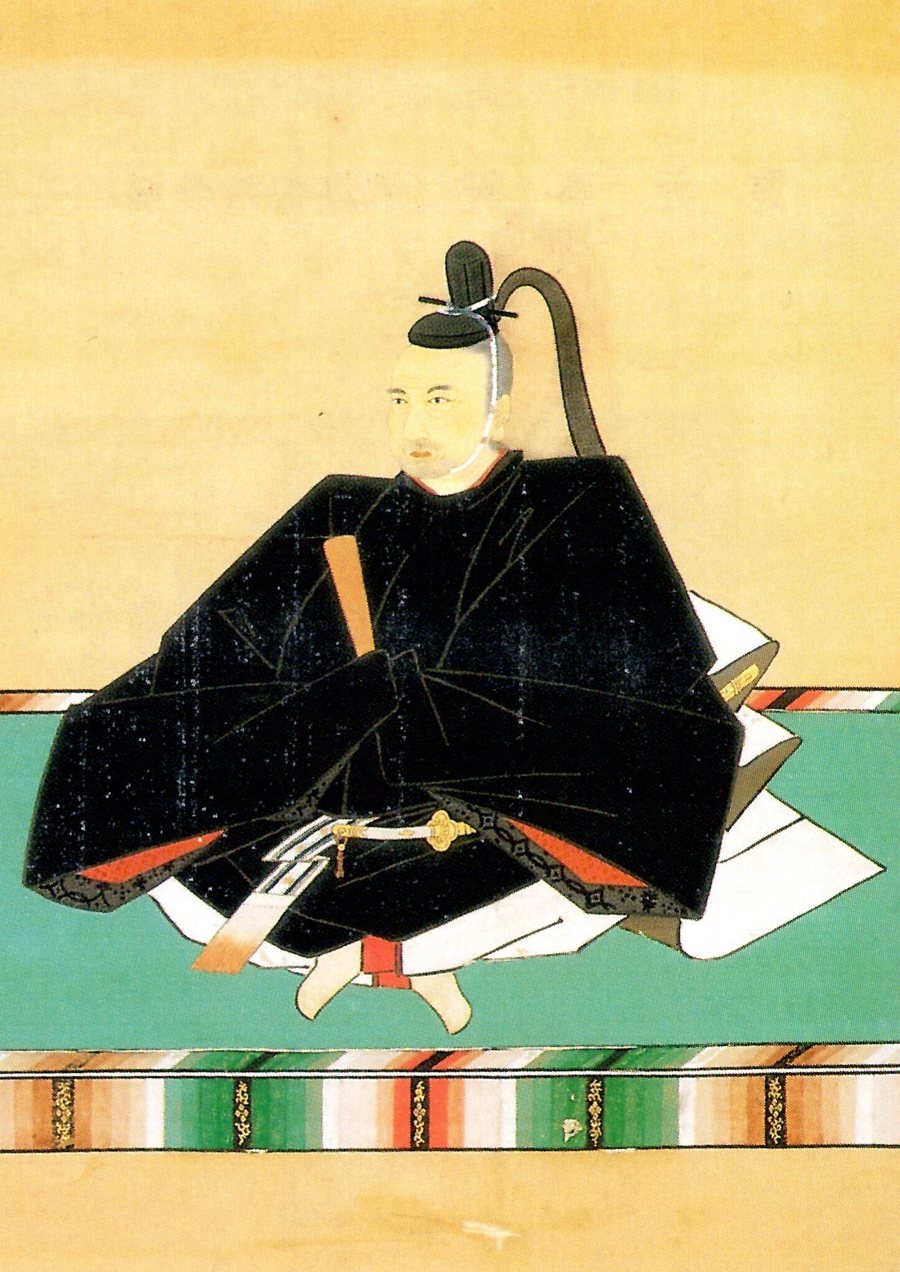
Yamamoto Tsunetomo was born in 1659, twenty-one years after the suppression of the Shimabara rebellion, the last real campaign of the Tokugawa peace, and he never fought in a battle. From the age of nine he served Nabeshima Mitsushige, the second lord of the Saga domain in Kyushu. When Mitsushige died in 1700, Tsunetomo wished to follow his lord in death, by the practice called junshi, but the practice had been forbidden, by the shogunate in 1663 and by Mitsushige himself in his own domain. So Tsunetomo shaved his head, became a Buddhist monk, and retired to a hermitage outside Saga, in the words of one Japanese dictionary “in place of following his lord in death.” In 1710 a younger samurai, Tashiro Tsuramoto, who had lost his own post, began visiting him and writing down what he said. Over seven years the conversations became the eleven books of Hagakure, “hidden by leaves.” The colophon asks that the books be burned. They were not, but they circulated in manuscript within the domain, and the book was not printed until 1906.Dates from the Kotobank entries on Yamamoto Tsunetomo and Hagakure, and from Saga City’s materials on Tashiro Tsuramoto. The historian G. Cameron Hurst III called Tsunetomo “a weekend warrior who never engaged in combat”: “Death, Honor, and Loyality [sic]: The Bushidō Ideal,” Philosophy East and West 40, no. 4 (1990).
The most famous book about dying for one’s lord, then, was dictated by a man who had been forbidden to die for his, and who lived for another nineteen years. I do not say this to mock him. It explains the book’s tone, which is that of a man brooding on a death that was taken from him, and it explains why the book is less a record of how samurai lived than a fantasy of how they ought to have died. Here is the passage that opens it, in the translation by William Scott Wilson that I read before my fight:
The Way of the Samurai is found in death. When it comes to either/or, there is only the quick choice of death. It is not particularly difficult. Be determined and advance. To say that dying without reaching one’s aim is to die a dog’s death is the frivolous way of sophisticates. … We all want to live. And in large part we make our logic according to what we like. But not having attained our aim and continuing to live is cowardice. … If by setting one’s heart right every morning and evening, one is able to live as though his body were already dead, he gains freedom in the Way.
Elsewhere Tsunetomo prescribes a daily exercise. “Every day when one’s body and mind are at peace, one should meditate upon being ripped apart by arrows, rifles, spears and swords, being carried away by surging waves, being thrown into the midst of a great fire,” and so on through lightning, earthquakes and cliffs to “committing seppuku at the death of one’s master,” and “every day without fail one should consider himself as dead.” Read generously, as I read it at first, this is a technique for removing fear, close to the Stoic exercise of imagining one’s losses in advance. The book’s last clause even makes it a technique for living: one meditates on death in order to gain “freedom in the Way.” But the same voice says, in a passage that is easy to pass over, that he once went to an execution ground to practice beheading and “found it to be an extremely good feeling.” And it worries constantly about men. “In the last fifty years,” Tsunetomo says, “men’s pulse has become the same as women’s,” which proves to him “that men’s spirit had weakened and that they had become the same as women, and the end of the world had come.” That few men can now cut cleanly in beheadings is “further proof that men’s courage has waned.” Under the whole book runs an anxiety that the age has gone soft, that men are turning into women, and that the cure is a resolve to die.
Yet the same book contains its own refutation, and Tsunetomo knew it. In the second book he says this:
Human life is truly a short affair. It is better to live doing the things that you like. It is foolish to live within this dream of a world seeing unpleasantness and doing only things that you do not like. But it is important never to tell this to young people as it is something that would be harmful if incorrectly understood. Personally, I like to sleep.
The founding text of the cult of death keeps, for its old men, a private doctrine of pleasure and a fondness for sleep, and withholds it from the young. I was one of the young men the public doctrine was meant for, and the public doctrine is what I read.
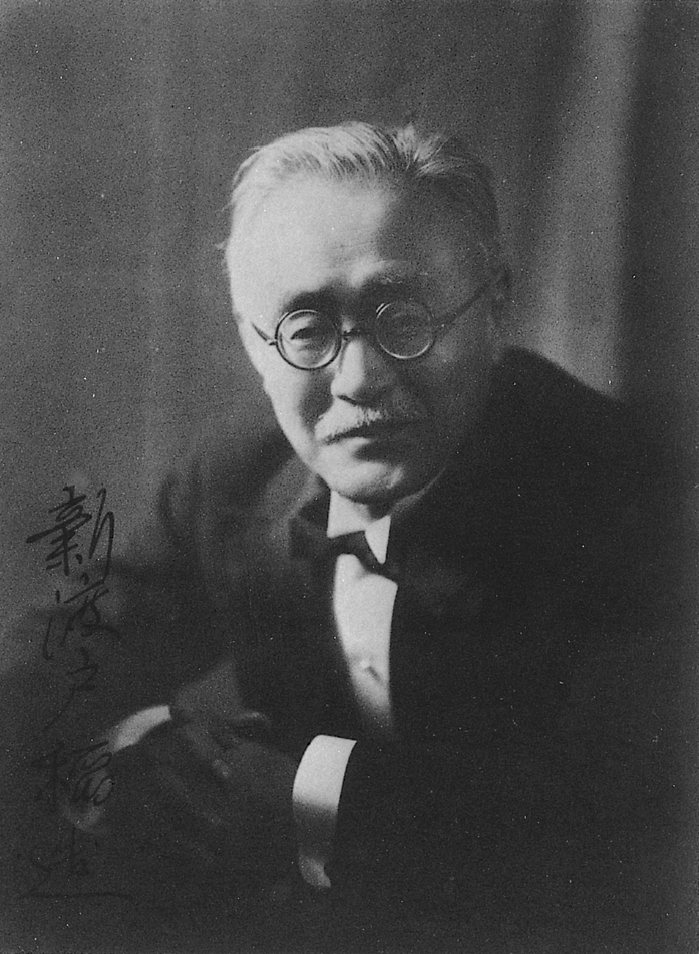
Hagakure is also unusual among premodern texts in using the word bushidō at all. When the compilers of a wartime anthology of samurai writings, Bushidō zensho (1942), gathered 118 documents from before the Meiji period, the word appeared in only thirteen of them, and the historian Oleg Benesch concludes that it was “virtually unknown before 1890.”Oleg Benesch, Inventing the Way of the Samurai: Nationalism, Internationalism, and Bushido in Modern Japan (Oxford, 2014), drawing on his dissertation (University of British Columbia, 2011), pp. 9 and 14. The word became famous through a book written in English. Nitobe Inazō, an agricultural economist and a Quaker who had studied in Baltimore and in Germany and married an American, published Bushido: The Soul of Japan in Philadelphia in 1900. In the preface he explains why. A Belgian jurist, Émile de Laveleye, had asked him whether Japanese schools taught religion, and when Nitobe said no, the old man stopped and repeated, “‘No religion! How do you impart moral education?’” Nitobe could not answer at once, and when he worked out where his notions of right and wrong had come from, he found “that it was Bushido that breathed them into my nostrils.” He admits in the first chapter that “it is not a written code,” but “more frequently … a code unuttered and unwritten.” The book was written for Westerners, with European parallels on every page, and it found them. It became a bestseller during the Russo-Japanese War. Nitobe reported that Theodore Roosevelt had read it and given “several dozens of copies” to his friends, and in 1908 Robert Baden-Powell told the readers of Scouting for Boys that “the Japanese have their Bushido, or laws of the old Samurai warriors, just as we have chivalry or rules of the knights of the Middle Ages.”
Not everyone was persuaded. Basil Hall Chamberlain, the leading British scholar of Japan, who had praised Nitobe’s book, wrote a pamphlet in 1912 called The Invention of a New Religion:
Bushido was unknown until a decade or two ago! The very word appears in no dictionary, native or foreign, before the year 1900. Chivalrous individuals of course existed in Japan, as in all countries at every period; but Bushido, as an institution or a code of rules, has never existed. The accounts given of it have been fabricated out of whole cloth, chiefly for foreign consumption.
Chamberlain overstated the case, since the word does occur in Edo texts, Hagakure among them. But modern historians have largely come around to his view. Benesch argues that “bushidō developed from a search for identity during Japan’s modernization in the late nineteenth century,” that the victory over China in 1895 set off a “bushido boom” that peaked during the war with Russia, and that the “imperial bushido” of the philosopher Inoue Tetsujirō “dominated bushido discourse in Japan until 1945.” Karl Friday, a historian of the medieval warrior, points out that the ties between medieval lords and their warriors were “contractual, based on mutual interest and advantage,” and that “the military tradition of the medieval samurai has very little in common with the ‘bushidō’ that was current in the early twentieth century.”Karl F. Friday, “Bushidō or Bull? A Medieval Historian’s Perspective on the Imperial Army and the Japanese Warrior Tradition,” The History Teacher 27, no. 3 (1994): 339–49. Hurst, cited above, concludes that modern bushido “might in fact be a modern creation, with no real link to any Japanese traditional set of ethics, real or imagined.”
So the bushido that reached me was made in the decades around 1900, for two audiences at once: Westerners who wanted to find in Japan a chivalry like their own, and a modernizing state that needed soldiers. And it was made for men. Nitobe calls it “a teaching primarily intended for the masculine sex,” and says that “it was considered unmanly for a samurai to betray his emotions on his face.”
Death Lighter than a Feather
The state got what it wanted first. In 1882 the Meiji emperor issued a rescript to soldiers and sailors, which recruits learned by heart until 1945. It tells them to “bear in mind that duty is weightier than a mountain, while death is lighter than a feather.” The image is borrowed from China, from a letter by the historian Sima Qian, and the borrowing is revealing. Sima Qian had been sentenced to castration for defending a disgraced general before the emperor, and a gentleman so punished was expected to kill himself rather than live with the shame. He did not. In his letter to his friend Ren An he explains why: every man has one death, which may be heavier than Mount Tai or lighter than a goose feather, depending on what it is used for, and he chose to live in disgrace in order to finish his history of China.Sima Qian, in the letter as preserved in Ban Gu’s Book of Han: 人固有一死,死有重於泰山,或輕於鴻毛,用之所趨異也 (“Every man has one death; a death may be heavier than Mount Tai or lighter than a goose feather, depending on what it is used for”). The rescript: 義は山嶽よりも重く死は鴻毛よりも輕しと覺悟せよ. It keeps Sima Qian’s goose feather, 鴻毛, and gives the weight of the mountain to duty. The letter’s authenticity is disputed, but it has been read as Sima Qian’s for two thousand years. The rescript took its image of a light death from a castrated man’s defense of choosing to live. It kept the half about the feather.
The Field Service Code of January 1941, issued under the army minister Tōjō Hideki, went further: “If alive, do not suffer the disgrace of becoming a prisoner; in death, do not leave behind a name soiled by misdeeds.” From May 1943, when the garrison on the Aleutian island of Attu was wiped out, the army called such last stands gyokusai, a “shattered jewel,” after a line in a Chinese chronicle, “a real man would rather be a shattered jewel,” in which the word for a real man, daijōbu, means a man in the full sense. Of about 2,600 Japanese defenders on Attu, twenty-eight were taken prisoner. In October 1944 the navy, under Vice Admiral Ōnishi Takijirō, formed the first special attack units, the tokkō or kamikaze. By the end of the war about four thousand airmen had died in them. On 16 August 1945, the day after the surrender broadcast, Ōnishi cut open his belly, refused a second to finish him, and took about fifteen hours to die.
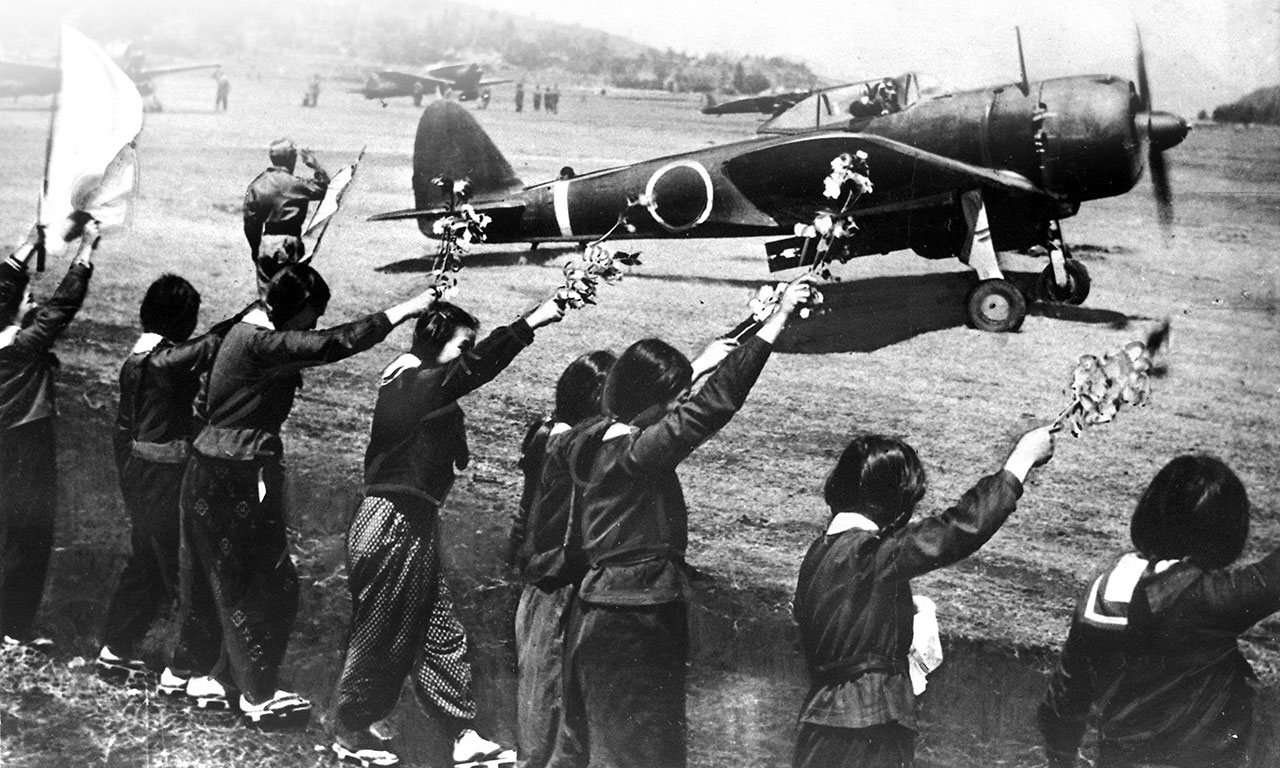
Hagakure itself was everywhere in those years. Dozens of editions were printed between 1936 and 1944, among them a pocket edition co-edited by the philosopher Watsuji Tetsurō. But the often-repeated story that kamikaze pilots carried it into their planes has little evidence behind it. A study of the last writings of 392 tokkō pilots traces the history they invoked: the ancient frontier guards whose poems are in the Man’yōshū, the nineteenth-century loyalist Yoshida Shōin, and above all the fourteenth-century loyalist Kusunoki Masashige, whose brother’s vow to be reborn seven times to serve the country appears in four percent of the letters. Hagakure is not among them.Bill Gordon, “The Last Writings of Japan’s Special Attack Corps Members” (M.Phil. thesis, Wesleyan University, 2020). Air tokkō deaths: 2,531 navy and 1,417 army, according to the memorial association’s count. The state did not need Tsunetomo, since it had written its own scriptures. A code that despised its own soldiers’ surrender also despised the surrender of others. The Tokyo war crimes tribunal found that 27 percent of American and British prisoners held by Japan died in captivity, against 4 percent of those held by Germany and Italy, and blamed among other causes the teaching that “it is an ignominy to surrender.” Freud thought that the death drive, turned outward, becomes aggression: “This aggressive instinct is the derivative and the main representative of the death instinct.”Civilization and Its Discontents (1930), Standard Edition 21:122. On the tribunal’s figures and their causes, which also include starvation and the collapse of supply, see Friday, “Bushidō or Bull?” The contempt for one’s own life and the contempt for a prisoner’s were the same contempt.
The men who would make the great samurai films of the 1950s and 1960s saw this from the inside. Toshirō Mifune, Kurosawa’s star, was drafted into the army air service in 1940 and stayed a private first class because he talked back to his superiors. In 1945 he was at a small base in Kumamoto where teenage tokkō pilots took off, and he photographed them before they left. According to his Japanese biographers he told them that when the end came they should shout “Mother!” rather than “Long live the Emperor!” Masaki Kobayashi, as I wrote in my essay on Kwaidan, refused promotion above private for the whole war.
Bushi and Rōnin
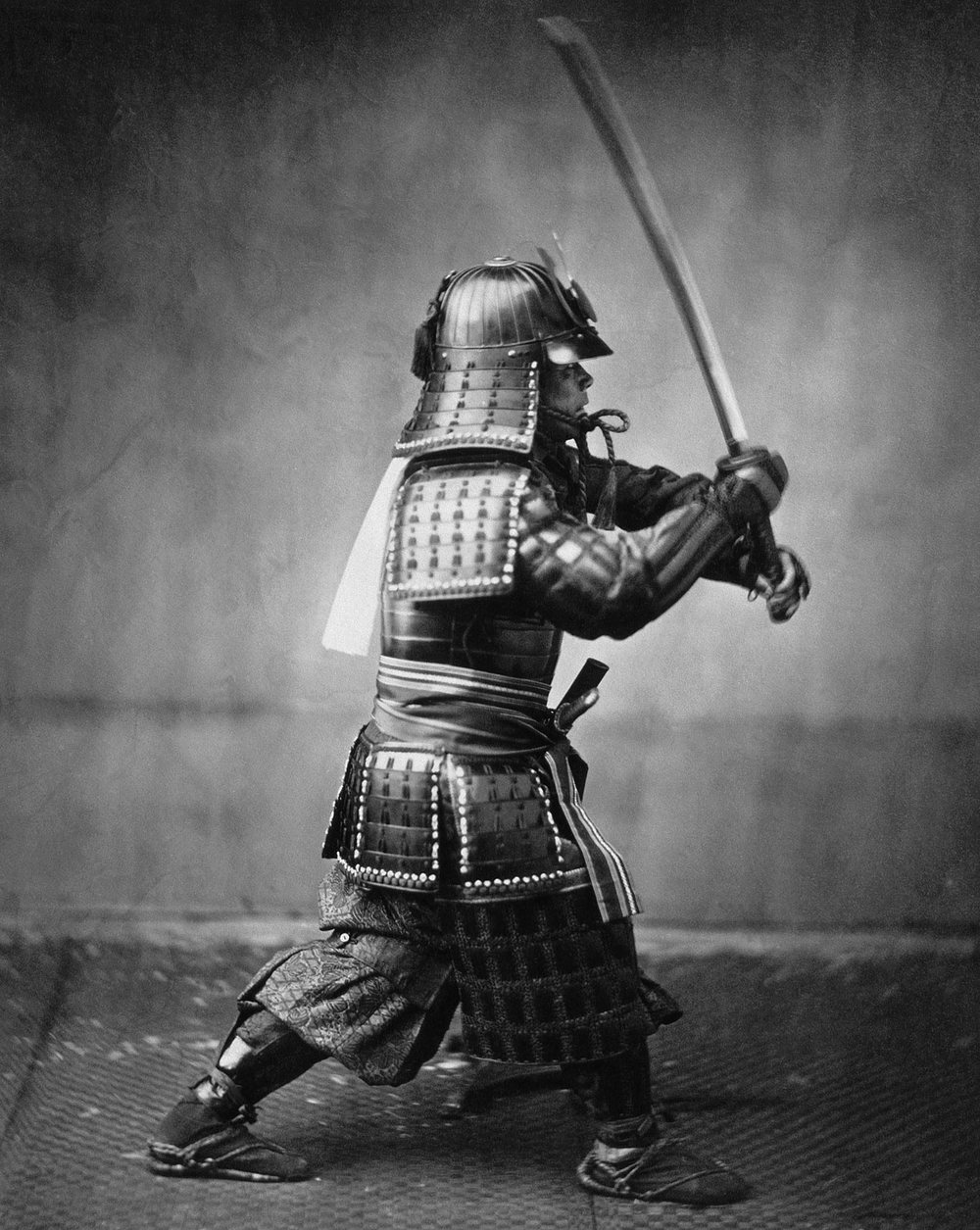
The word samurai comes from a verb, saburau, which means to wait upon a noble, to serve at his side. A samurai was by definition someone’s man. A warrior without a master was a rōnin, written with characters that originally meant a vagrant, someone who had left his registered home; the popular English gloss “wave man” comes from reading the first character literally. In the first half of the seventeenth century the Tokugawa shogunate confiscated or reduced the domains of well over a hundred lords, and their retainers lost their places. One of those lords was Fukushima Masanori of Hiroshima, whose domain was taken in 1619 because he had repaired his castle without permission, and whose former retainer is the hero of Kobayashi’s Harakiri. The masterless men were a political danger. In 1651 a teacher of military science, Yui Shōsetsu, plotted a rising in Edo with rōnin; the plot was discovered, he killed himself, and later that year the shogunate relaxed the rule against adopting an heir on one’s deathbed, which had extinguished many houses and thrown their men out of work.
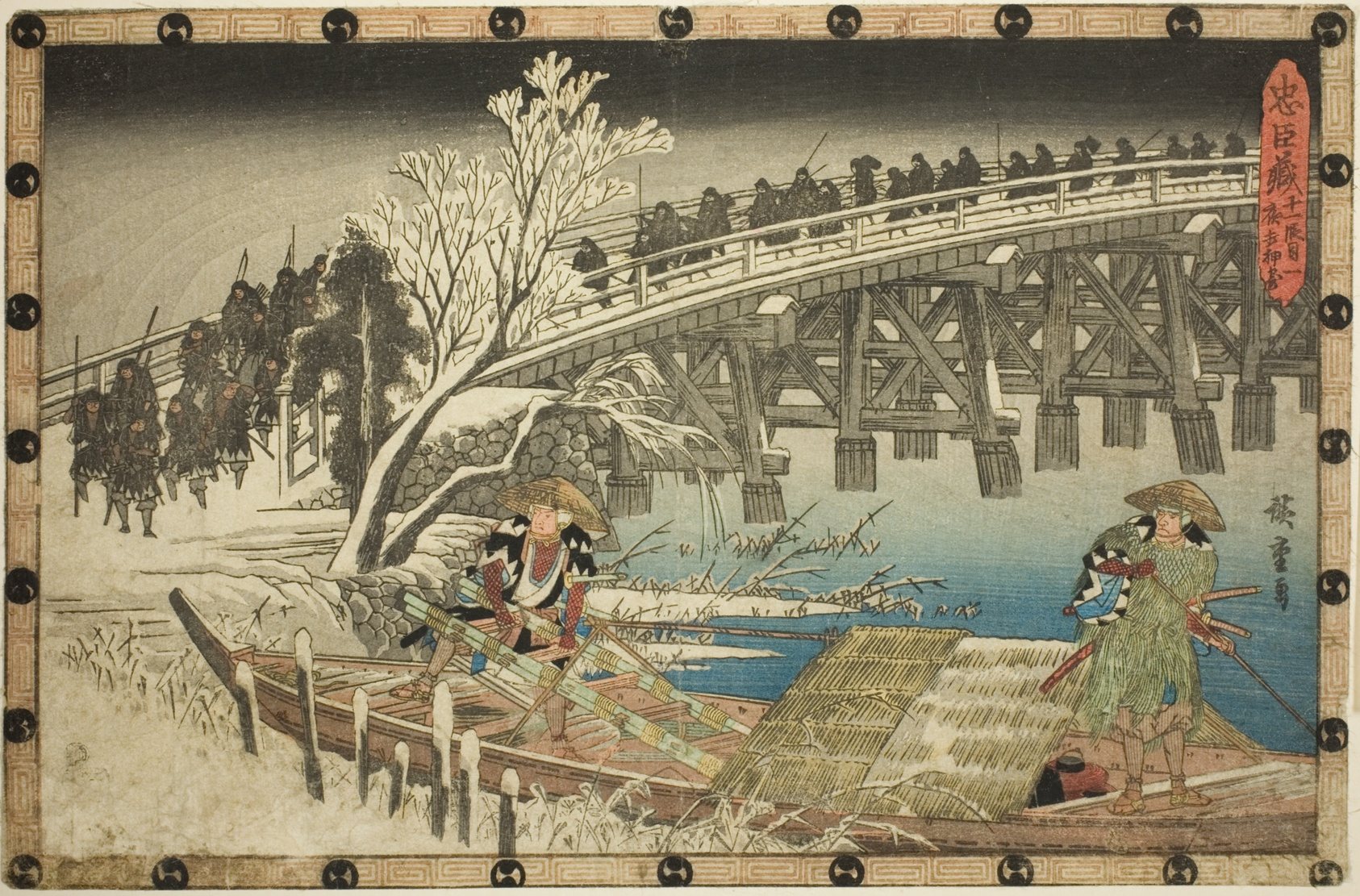
The most famous rōnin in Japanese history are famous for behaving as though they still had a master. In 1701 the lord of Akō, Asano Naganori, drew his sword on a shogunal master of ceremonies, Kira Yoshinaka, inside Edo Castle, and was ordered to commit seppuku the same day. His domain was confiscated. Nearly two years later, on a winter night at the end of January 1703, forty-seven of his former retainers broke into Kira’s mansion, killed him, and carried his head to their lord’s grave. The shogunate ordered them to commit seppuku, and forty-six of them did, in March 1703. Their story became Chūshingura, the most popular play in the Japanese repertory, and Ruth Benedict called it “the true national epic of Japan.” Even so, contemporaries argued about it, and Hagakure was among the critics. The rōnin, Tsunetomo complained, had erred in not committing seppuku at once at their lord’s grave, and they had waited far too long to strike: “If Lord Kira had died of illness within that period, it would have been extremely regrettable.” To Tsunetomo their careful planning was itself the fault. A retainer should not calculate. He should die.
The distinction matters for everything that follows. A bushi’s life belongs to his lord, and so does his death; that is what Hagakure means by dying. A rōnin’s life belongs to no one. He has a sword and a code, or the memory of one, and nobody to give his death to. Hagakure’s ideal is the retainer. The hero of the samurai film is almost always the rōnin.
The samurai film nearly did not survive the war. On 16 November 1945 the American occupation ordered the withdrawal of films that had been used “to propagate nationalistic, militaristic and feudalistic concepts; i.e., conformity to a feudal code, contempt for life, creation of the ‘Warrior Spirit.’” A week later its Civil Information and Education Section listed thirteen themes that new films could not have. Among them were “showing revenge as a legitimate motive,” “portraying feudal loyalty or contempt of life as desirable and honorable,” “approving suicide either directly or indirectly,” and “dealing with or approving the subjugation or degradation of women.” Two hundred and thirty-six films were banned, and many of the prints were burned. Adaptations of Chūshingura were impossible “because of their emphasis on loyalty to lords,” and only four period films were allowed to be made in 1946. The film historian Kyoko Hirano, who studied the censors’ records, found that they drew a distinction between swords and guns. Japanese swordsmen, they thought, fought for “personal revenge or to defend the lords to whom they were loyal,” while the gunmen of American westerns fought “only to defend justice,” and “the American authorities regarded swords as inherently more cruel than guns.”Kyoko Hirano, “The Banning of Japanese Period Films by the American Occupation,” Iconics 1 (1987): 193–208, pp. 195–98; see also her Mr. Smith Goes to Tokyo (1992). Kurosawa’s own period film The Men Who Tread on the Tiger’s Tail (1945), about the loyalty of the monk Benkei to his lord, was not released until 1952. The Occupation ended in April 1952, and Seven Samurai opened two years later. The critic Tadao Sato thought the revival of the period film after the Occupation was “probably not so much a restoration of feudal thought as a continuation of the old fear—namely, that postwar Japan’s weakness would continue unless the will and pride of the samurai was preserved.”
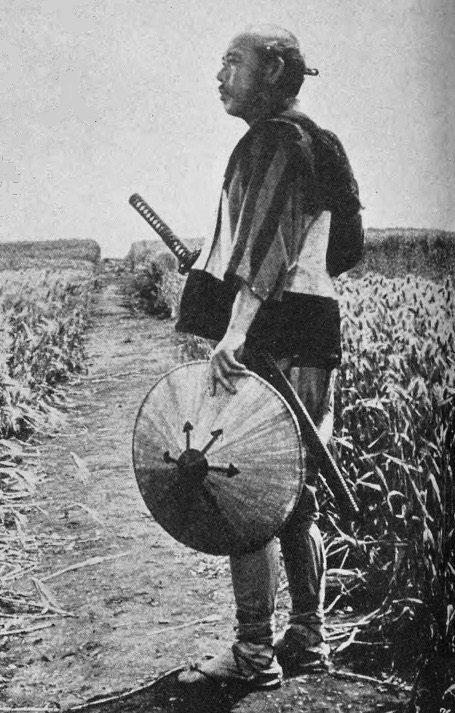
Seven Samurai is set in 1586, near the end of the century of civil wars, and every one of its samurai is a rōnin. A village of farmers, who expect bandits after the harvest, goes to town to hire samurai and can offer them nothing but rice. The first one they find, Kanbei, played by Takashi Shimura, is introduced in a scene that seems to me more remarkable each time I see it. A thief has taken a child hostage in a barn. Kanbei asks a priest to shave his head, borrows the priest’s robe, walks into the barn as a harmless monk carrying rice balls, and kills the thief. The topknot was the mark of a samurai. As the critic Philip Kemp notes, “the amazement and horror of the onlookers convey the enormity of what he’s doing: he’s cutting off his own topknot, a key signifier of his samurai status,” and yet “to Kambei, such an outward display is unimportant compared with his duty as a samurai to help the helpless.”Philip Kemp, “A Time of Honor: Seven Samurai and Sixteenth-Century Japan,” Criterion Collection essay, 2006. The first thing the film’s wisest samurai does is to give up the sign of his status in order to save a child. I will come back to this.
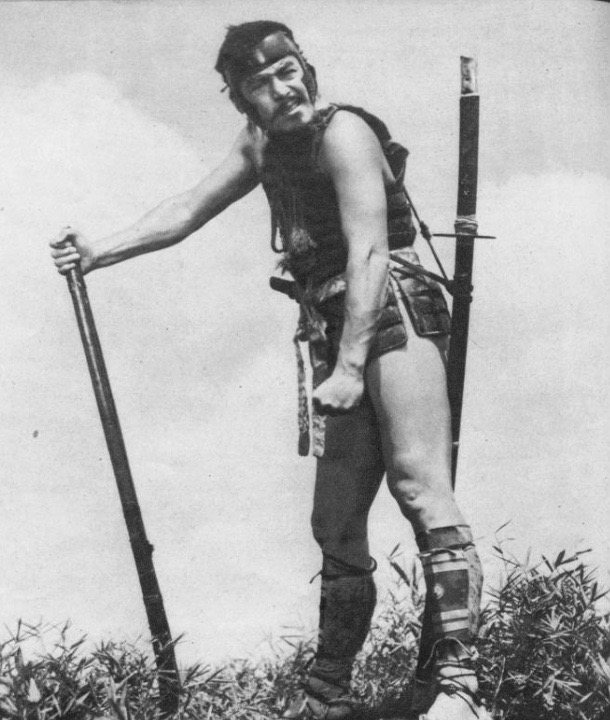
The seventh samurai is not a samurai at all. Kikuchiyo, played by Toshirō Mifune, is a farmer’s son who carries a stolen genealogy, and the others laugh when they read that its owner was born in 1574, which would make him thirteen years old. (That is how we know the film’s date.) The name he has taken from the scroll, Kikuchiyo, is a child’s name, the kind a boy carries before his coming-of-age ceremony. When the samurai discover that the villagers have hidden armor and spears stripped from fleeing samurai whom they hunted down and killed, Kikuchiyo turns on them in the film’s angriest speech. Farmers are mean, cowardly and murderous, he shouts, and who made them so? The samurai did. In the end four of the seven are dead. Kanbei watches the farmers singing as they plant the new rice and says the film’s last words: “In the end, we’ve lost this battle too … the victory belongs to those peasants, not to us.” It is how he introduced himself at the start: “I may have seen my share of battle, but always on the losing side.”
Kurosawa admired John Ford, and his assistant Teruyo Nogami remembered him saying that when he was old he wanted to be that kind of director. According to his crew he shot the last battle in pouring rain because westerns are always sunny. But he was precise about the difference between the two genres. Asked about the American remake, The Magnificent Seven (1960), he is reported to have said, “Gunmen aren’t samurai.”
In Yojimbo (1961), Mifune plays a rōnin with no village to save. He comes to a crossroads, throws a stick in the air, and walks the way it points, and in the next shot a dog trots past with a human hand in its mouth. The town he arrives in is run by two gangs, and he sells his sword to each in turn and watches them destroy each other. Asked his name, he looks out at a mulberry field and calls himself Kuwabatake Sanjūrō, “Mulberry-field Thirty-year-old,” then adds that he is going on forty. The critic Alexander Sesonske put it plainly: “As a ronin—or masterless samurai—he has no loyalty, and in Yojimbo there is no right side.” It is the samurai as a free agent in a market for violence, and it is no accident that this was the Kurosawa film to be remade as a western, by Sergio Leone, without permission. Kurosawa sued, and he and his co-writer settled for the distribution rights in Japan, Taiwan and South Korea and a reported fifteen percent of the worldwide receipts of A Fistful of Dollars (1964).
The sequel, Sanjuro (1962), turns on a line spoken by its gentlest character. Nine young samurai, idealistic and incompetent, are trying to save their clan from its corrupt officials, and Sanjūrō, now calling himself Tsubaki, “Camellia,” helps them with open contempt. They rescue the chamberlain’s wife, an older woman who is unhurried and kind to everyone, and she tells him what she sees: “You’re like a sword without a sheath. You cut well, but the best sword is kept in its sheath.” At the end Sanjūrō duels the villains’ swordsman, Muroto, played by Tatsuya Nakadai. The duel lasts an instant and ends in a fountain of blood. The young men crowd around to admire him, and he turns on them: “He was just like me. A drawn sword that wouldn’t stay in its sheath. But you know, the lady was right. The best sword is kept in its sheath. You’d better stay in yours.”English subtitles differ between editions. The Japanese line is 本当にいい刀は鞘に入ってる, “a really good sword stays in its sheath.” Then he walks away. Kurosawa’s most famous rōnin ends by refusing admiration for the very thing that makes him a hero.
Even in these films, which are among the most exciting ever made, the rōnin is not a model. He is the man the ideal leaves behind: hired for rice, named after a field, cut loose from any lord, very good at killing and tired of it. This is the figure the West fell in love with.
Gunmen Aren’t Samurai
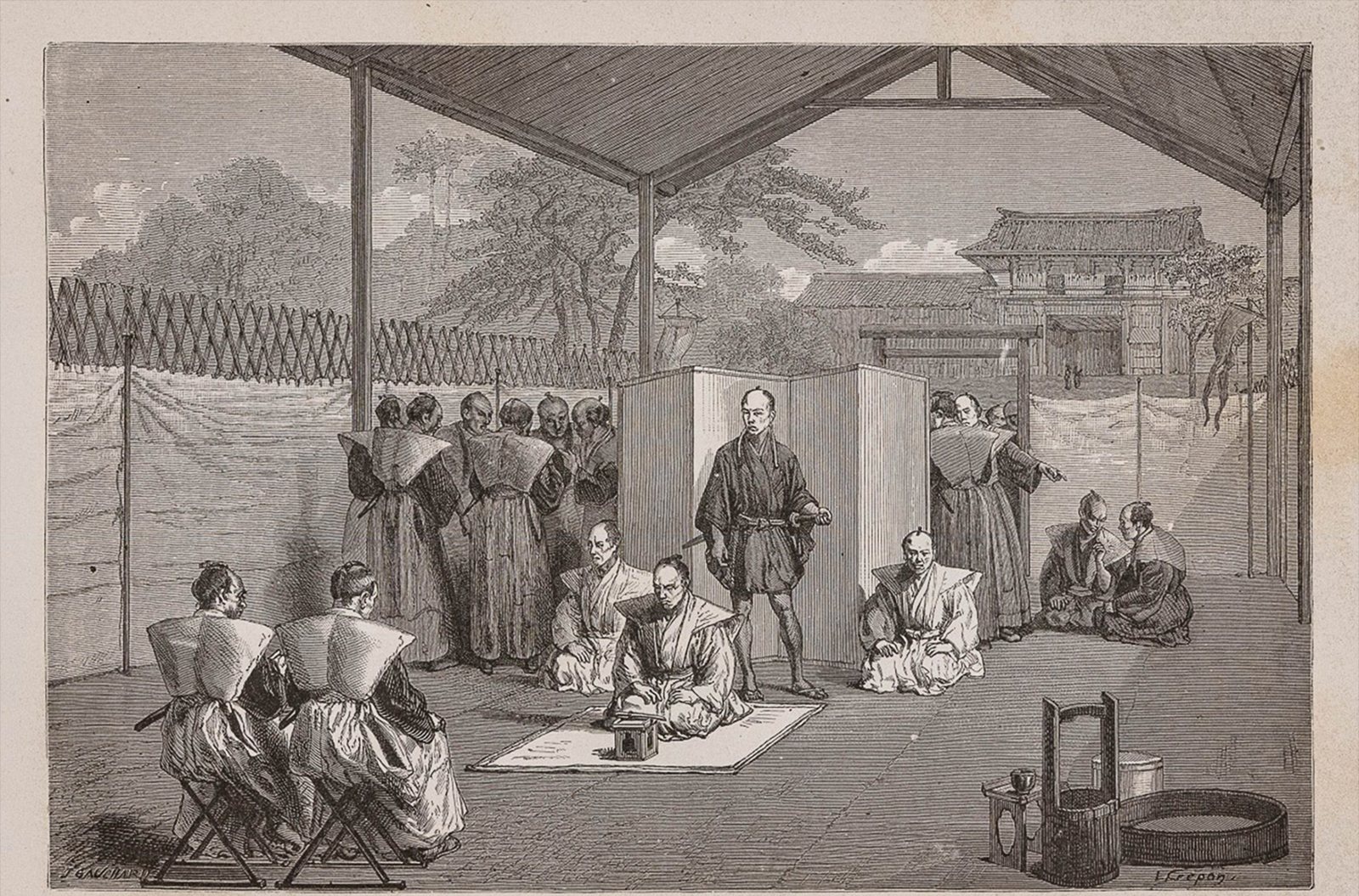
The Western image of the samurai begins with an execution. On 2 March 1868, in the first months of the new imperial government, an officer of the Bizen domain named Taki Zenzaburō, who had ordered his men to fire on foreigners in Kobe, disemboweled himself in a temple before seven foreign witnesses. One of them was the British diplomat Algernon Mitford, who published an account of it in Tales of Old Japan (1871). “Up to that time,” Mitford wrote, “no foreigner had witnessed such an execution, which was rather looked upon as a traveller’s fable.” Taki addressed the witnesses before he began: “For this crime I disembowel myself, and I beg you who are present to do me the honour of witnessing the act.” Mitford records that “during this sickeningly painful operation he never moved a muscle of his face,” that “with one blow the head had been severed from the body,” and that “it was horrible.” Yet it was “impossible at the same time not to be filled with admiration of the firm and manly bearing of the sufferer.” Nitobe reprinted the account in Bushido.
Mitford’s account has the shape of most Western writing about the samurai since: horror and admiration in a single sentence, and admiration above all for the man’s manliness. The ceremony also needed witnesses; Taki asked the foreigners to watch. The anthropologist Ruth Benedict, who wrote The Chrysanthemum and the Sword (1946) for the American Office of War Information without ever being able to visit Japan, built her famous distinction between guilt cultures and shame cultures on that point: “Shame is a reaction to other people’s criticism … it requires an audience or at least a man’s fantasy of an audience. Guilt does not.” Her distinction has been much criticized since, but the samurai’s death as she and Mitford saw it is a performance, and its audience was increasingly Western.
The film remakes did what the Occupation censors had done, and turned the samurai into gunmen. The Magnificent Seven, which John Sturges made from Seven Samurai, keeps the village and the hired swords and drops what matters most in Kurosawa: the class difference between the hired men and the farmers, and the defeat at the end. Kurosawa said later that “it is not a version of ‘Seven Samurai.’” A Fistful of Dollars made Mifune’s rōnin into Clint Eastwood’s Man with No Name. The traffic went both ways, since Kurosawa had learned from Ford, but what crossed easily was the rōnin. A masterless man with a weapon and a private code was something the West already had, in the gunfighter. What did not cross was the bushi, the man whose life and death belong to someone else.
The Last Samurai (2003) is the most expensive version of the fantasy. Tom Cruise plays an American veteran of the Indian wars, hired to train the new imperial army, who is captured by rebel samurai, learns their ways, and fights beside them against the guns of the modern state. Their leader, Katsumoto, played by Ken Watanabe, is loosely based on Saigō Takamori, who led the Satsuma rebellion of 1877 and is often called the last samurai. The historian Mark Ravina, Saigō’s biographer, called Cruise’s character “about 80 to 90 percent fictional,” an instance of “the old device of bringing American audiences into foreign stories by having an American character advance the plot.” The real Saigō had commanded the imperial armies that overthrew the shogunate, and the government he helped to build “stripped the samurai of all that made them samurai.” His rebels fought with rifles and artillery. And he probably did not commit seppuku at all. Ravina has shown that the autopsy found no wound in his abdomen. He was crippled by a bullet and beheaded by a comrade, and the story of his suicide was a legend that grew up almost at once. “Then, as now,” Ravina says, “they gave the people the ending they wanted.”Mark Ravina, “The Apocryphal Suicide of Saigō Takamori: Samurai, Seppuku, and the Politics of Legend,” Journal of Asian Studies 69, no. 3 (2010): 691–721. The other quotations are from an interview with Ravina in Emory Magazine, Spring 2004.
FX’s Shōgun (2024), the best Western version so far, shows how much has changed and how much has not. Hiroyuki Sanada, who produced it and played the warlord Toranaga, said that Hollywood “sometimes … misunderstands our culture,” and that he wanted to “introduce the world correctly.” Its Japanese characters speak Japanese, with subtitles, where those of the 1980 miniseries were left untranslated, and it won a record eighteen Emmys. Yet its emotional climax is still a death chosen for honor. Lady Mariko, modeled on the Christian noblewoman Hosokawa Gracia, who in 1600, forbidden suicide by her faith, had a retainer kill her rather than be taken hostage, chooses death to break the regent’s hold on the hostages in Osaka. “Accepting death isn’t surrender,” she says. “Flowers are only flowers because they fall.” The warlord sums it up in the final episode: he “sent a woman to do what an army never could.” Netflix’s animated Blue Eye Samurai (2023), whose mixed-race heroine has to pass as a man in order to carry a sword, is one of the few Western versions to make the masculinity of the samurai its subject.
In all of these the samurai is two things the West wanted at once: the rōnin’s freedom and the retainer’s beautiful death. They do not fit together, since the retainer’s death is beautiful only because it is given to someone else. What holds them together is a feeling that both cultures share, and which the samurai film shows more nakedly than any other genre I know. To see it I want to go back to Harakiri.
The Topknot
I wrote about Harakiri (1962) in my essay on Kwaidan, as the story of a clan that will kill to keep its honor intact. Here I want to look at one detail of it. In 1630 a rōnin, Tsugumo Hanshirō, played by Tatsuya Nakadai, comes to the mansion of the Iyi clan, in the Japanese original the Ii, the real lords of Hikone, and asks for permission to commit seppuku in its courtyard. He was once a retainer of the Fukushima house of Hiroshima. Some months earlier his son-in-law, Chijiiwa Motome, had made the same request, hoping to be paid to go away, because he needed money for a doctor for his wife and child. The clan held him to his word and made him disembowel himself with the bamboo blade he carried, since he had pawned his real sword. Hanshirō has come for revenge, but not the revenge we expect.
Before coming to the mansion, Hanshirō has hunted down the three retainers who led Motome’s humiliation: Omodaka Hikokurō, Yazaki Hayato and Kawabe Umenosuke. He has not killed them. He has cut off their topknots. In the courtyard he tells his story and throws the three topknots onto the white sand. The men themselves are absent; they have sent word that they are ill. To have one’s topknot taken by another man was a disgrace that not even death could redeem, and Hayato and Umenosuke had meant to stay home sick until their hair grew back. The clan makes sure they never do. Omodaka has already killed himself, and the other two are ordered to. At the end, after Hanshirō has been shot down by musketeers, the clan records every death as illness, the shogunate commends the house for its conduct, the armor Hanshirō smashed is set back on its stand, and a workman cleaning up drops a severed topknot into his bucket.
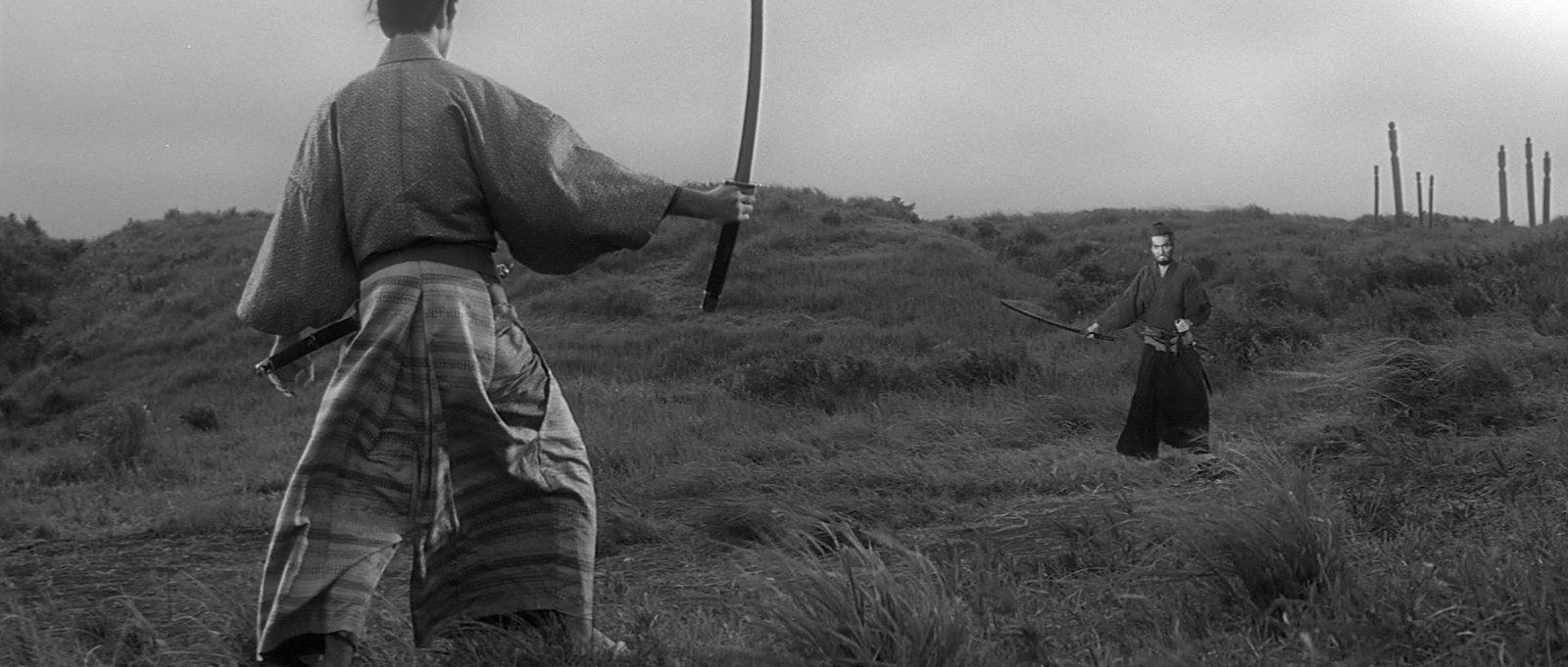
Film historians describe the topknot as “the symbol of his rank as a samurai and of his adult manhood” (Audie Bock) and as one of “the symbols of samurai manhood” (Paul Varley).Audie Bock, Japanese Film Directors (1978), chapter on Kobayashi; Paul Varley, Japanese Culture, 4th ed. (2000), p. 323. I want to take them literally. What Hanshirō does to the three men is a castration, and the horror of the film lies in what the code does next. It turns the castration into death.
Freud is the obvious guide here, and not only because castration was his subject. More than any other modern thinker he shaped how the twentieth century talked about men, and in his account masculinity is organized around a threat. The term “castration complex” first appears in print in 1908, in a paper on children’s sexual theories, where Freud says that the effect of the threat “is proportionate to the value set upon that organ and is quite extraordinarily deep and persistent.” By 1925 it had become the hinge of his account of how boys become men. “Whereas in boys the Oedipus complex is destroyed by the castration complex,” he wrote, “in girls it is made possible and led up to by the castration complex.” In the boy the complex “is literally smashed to pieces by the shock of threatened castration,” and the father’s authority, taken inside, forms “the nucleus of the super-ego.” Conscience, in Freud’s story, is an internalized threat of castration.
Near the end of his life he went further. In “Analysis Terminable and Interminable” (1937) he wrote that analysis with men always arrives at the same obstacle, “a struggle against his passive or feminine attitude to another male,” which Alfred Adler had called the “masculine protest” and which Freud thought should have been called the “repudiation of femininity.” In men, he wrote, “the passive attitude, since it presupposes an acceptance of castration, is energetically repressed, and often its presence is only indicated by excessive overcompensations.” He thought this was bedrock, and in a footnote he reduced it further: “What they reject is not passivity in general, but passivity towards a male. In other words, the ‘masculine protest’ is in fact nothing else than castration anxiety.”Standard Edition 9:217 (1908); 19:256–57 (1925); 23:250–53 (1937). I do not think Freud’s biology is right, and few people now do. I use him as the most influential description of a structure of feeling, not as its explanation.
Put this beside Hagakure. The book that tells men to die is preoccupied with men becoming like women, and its ideal retainer gives himself entirely to another man, his lord. What the code cannot allow is any other kind of submission to another man: to surrender, to be captured, to be shamed, to be cut and go on living. Between castration and death it chooses death and calls the choice honor. That is what I mean by a masculine death drive. It is less a wish to die than a terror of being unmanned, intense enough to make death look like the only way of remaining a man. Freud described a “moral masochism” in which a man, to satisfy a cruel conscience, “must act against his own interests” and “must, perhaps, destroy his own real existence.”“The Economic Problem of Masochism” (1924), Standard Edition 19:169–70. Ian Buruma, writing about Japanese heroes in the 1980s, said the same thing in a sentence: “Macho in Japan is often masochism turned into a fine art.”
The ritual itself points the same way. By the Edo period the cut to the belly was often only a gesture, sometimes made with a fan in place of a blade, and the death came from the second, the kaishakunin, who cut off the man’s head. In a short note of 1922, “Medusa’s Head,” Freud wrote: “To decapitate = to castrate.”Standard Edition 18:273. In “The ‘Uncanny’” (1919) he had said that a severed head is uncanny because of its “proximity to the castration complex” (17:244). One need not accept Freud’s symbolic grammar to see what Harakiri sees: the ceremony that is supposed to save a man from shame ends with the act it was meant to avoid, performed by another man. Hanshirō’s topknots make visible what the ceremony hides. “After all,” he says, “this thing we call samurai honor is nothing but a façade.”
Freud was not the only one to connect hair and the genitals. The psychoanalyst Charles Berg argued in 1951 that cutting the hair always symbolizes castration, and the anthropologist Edmund Leach, who thought Berg went much too far, still found that rituals across the world fit a pattern: “long hair = unrestrained sexuality; short hair or partially shaved head or tightly bound hair = restricted sexuality; close shaven head = celibacy.”Edmund Leach, “Magical Hair,” Journal of the Royal Anthropological Institute 88, no. 2 (1958): 147–64; Charles Berg, The Unconscious Significance of Hair (1951). The samurai’s hairstyle, its crown shaved and the rest drawn tight into the topknot, sits exactly in the middle of Leach’s scale, a disciplined masculinity. The oldest version of the story in the Western tradition is Samson’s: “if I be shaven, then my strength will go from me, and I shall become weak, and be like any other man.”
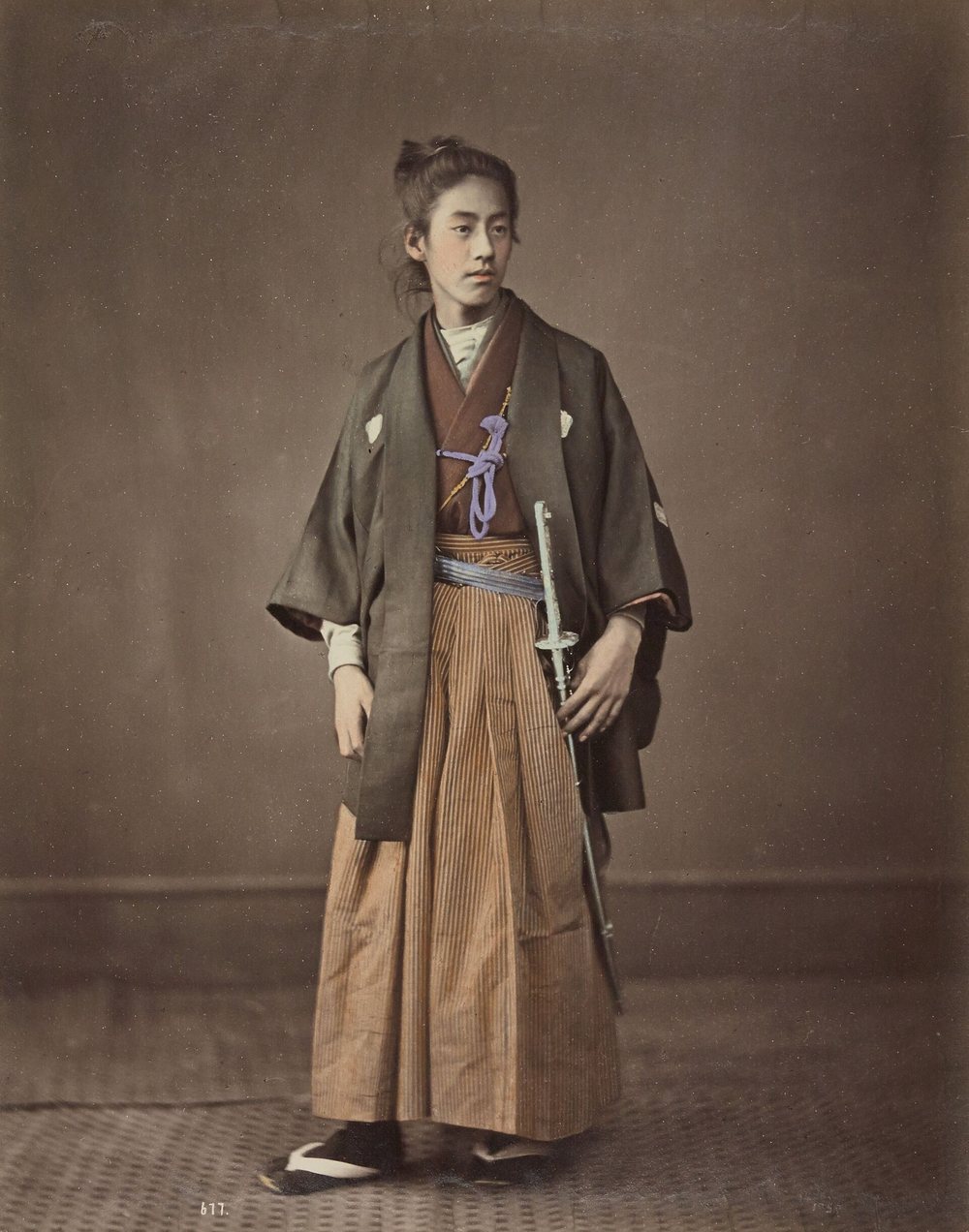
This puts the stories I have told so far in a new light. Tsunetomo, forbidden to die with his lord, shaved his head and became a monk “in place of following his lord in death.” Kurosawa’s Kanbei shaves his head to save a child. Kobayashi’s three retainers are shorn against their will and made to die. The same loss of the samurai’s hair means survival in the first story, renunciation in the second and death in the third, and what decides between them is whether a man can bear to be seen without it. Harakiri says the code is precisely what cannot bear it. The Meiji state settled the matter for the whole class. In 1871 it permitted men to cut off their topknots and to go without swords, a popular song promised that if you tapped a cropped head you would hear “the sound of civilization and enlightenment,” the emperor had his own topknot cut in 1873, and in 1876 the wearing of swords was banned.Suzanne G. O’Brien, “Splitting Hairs: History and the Politics of Daily Life in Nineteenth-Century Japan,” Journal of Asian Studies 67, no. 4 (2008): 1309–39, who notes that the 1871 edict permitted the haircut rather than ordering it, and that the song was already in print a few months before the edict. The samurai class was unmanned by decree, and the bushido of the 1900s was written, in part, by its sons.
Not everyone who saw Harakiri took its point, and the most famous viewer who did not was Yukio Mishima.
Sun and Steel
In 1963 Mishima wrote about Harakiri in a film magazine. If the director had meant the seppuku scenes to carry the anger of “modern humanism, which is merely an import,” he said, the audience’s reaction was beyond his calculations, because viewers watching the men die saw, without knowing it, “an expression of noble will, and a form of beauty.”Mishima Yukio, 「残酷美について」 (“On the Beauty of Cruelty”), Eiga geijutsu, August 1963. My translation, from the passage quoted in the Japanese Wikipedia article on the film. He was describing himself.
Mishima was born Hiraoka Kimitake in 1925. In 1945 he failed his army physical when a fever was misdiagnosed as tuberculosis, and he did not correct the doctor. The narrator of his first great novel, Confessions of a Mask (1949), realizes “vividly that my future life would never attain heights of glory sufficient to justify my having escaped death in the army.” Like Tsunetomo, Mishima was a man whose death had been taken from him, and like Tsunetomo he spent the rest of his life on it. He read Hagakure during the war and kept it by him afterward. “If there is one single book I have referred to continually in the twenty years since,” he wrote in Hagakure nyūmon (1967), his commentary on it, “that book is Hagakure.” Of its first sentence he said, “It was this sentence, however, that gave me the strength to live.” In the same book he used the vocabulary I have been using: “During the war, the death impulse was 100 percent liberated,” and “we are constantly exposed to the danger that the death drive suppressed within modern youth will someday explode.”Yukio Mishima, The Way of the Samurai: Yukio Mishima on Hagakure in Modern Life, trans. Kathryn Sparling (1977), pp. 4 and 6. He meant this as a criticism of the peace. He had also read the passage about doing what one likes and sleeping, and in a newspaper column of 1966 he praised Hagakure as a book “full of praise for human vitality and careful practical wisdom.” He read the whole book, that is, and chose the public doctrine.
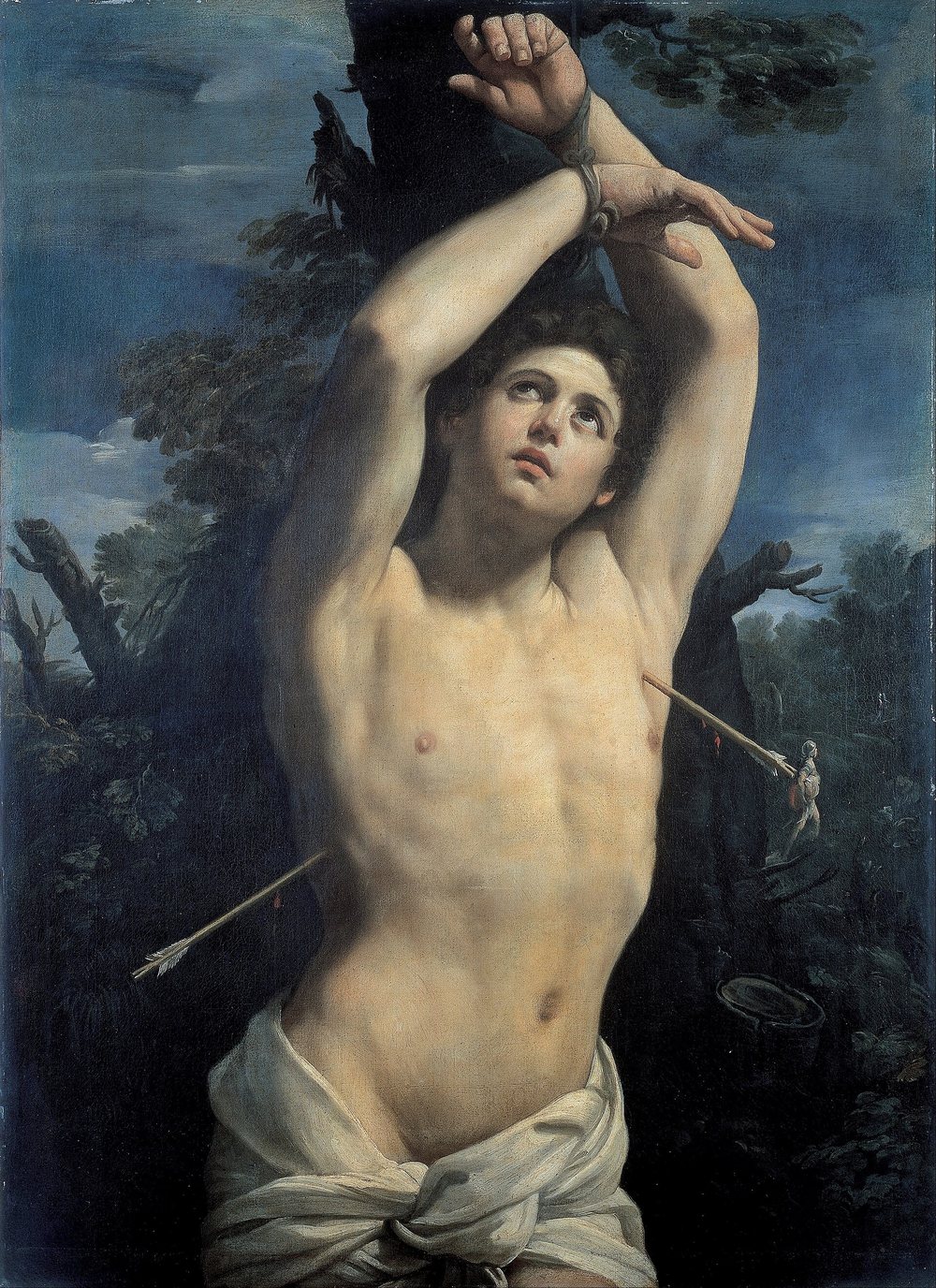
He knew Freud’s work and dismissed him as “the vulgar psychoanalyst of Vienna.” In Confessions of a Mask the narrator’s first sexual experience comes as he looks at a reproduction of Guido Reni’s Saint Sebastian, the beautiful young martyr bound to a tree and pierced with arrows; in 1968 Mishima had himself photographed in the saint’s pose. He had begun lifting weights in 1955. In Sun and Steel (1968) he explained that in his life “words came first of all; then—belatedly, with every appearance of extreme reluctance, and already clothed in concepts—came the flesh,” and that the body he had built served one purpose: “A powerful, tragic frame and sculpturesque muscles were indispensable in a romantically noble death.” A decade later the German writer Klaus Theweleit, studying the fantasies of the Freikorps veterans who fought the revolutionaries in Germany after 1918, described the same man. His “most urgent task” is “to pursue, to dam in, and to subdue any force that threatens to transform him back into the horribly disorganized jumble of flesh, hair, skin, bones, intestines, and feelings that calls itself human”; “each and every feeling is tightly locked in steel armor”; and he “longs for the moment when his body armor will explode.”Klaus Theweleit, Male Fantasies, vol. 2, Male Bodies: Psychoanalyzing the White Terror, trans. Erica Carter and Chris Turner (1989), pp. 160 and 179. Mishima’s title names the armor: steel.
In 1966 Mishima released Yūkoku (Patriotism), a half-hour film without dialogue that he wrote, directed and starred in, adapted from his own story. A young lieutenant, whose friends have joined the failed army mutiny of February 1936 and who expects to be ordered to attack them, disembowels himself beside his wife, who then kills herself, to the “Liebestod” from Wagner’s Tristan und Isolde. After Mishima’s death his widow had the prints destroyed; a negative survived and was found in 2005. In 1968 he founded the Tatenokai, the Shield Society, a private militia of about a hundred students. On 25 November 1970 he and four of its members went to the Tokyo headquarters of the Ground Self-Defense Force’s Eastern Army at Ichigaya, tied up its commanding general, and demanded that the troops be assembled. From a balcony he called on them to rise and restore the emperor to power. They jeered, and the helicopters overhead drowned him out. He went back inside and cut open his belly. His follower Morita Masakatsu, chosen to behead him, failed, and another member, Koga Hiroyasu, finished the task and then beheaded Morita, who had cut himself in turn. That morning Mishima had left the last installment of his last novel for his publisher. The prime minister said, “I can only think he went mad.” His translator and biographer John Nathan saw in it “the artist perishing and in perishing becoming his own masterpiece.”
Mishima’s death completes the story that began with Tsunetomo. The retainer forbidden to die dictated a book about dying; the writer whose generation’s death had passed him by took the book at its word, built a body for the purpose, and staged the death before an audience of soldiers and reporters. What nobody had written was the audience’s part. The soldiers of a democratic army laughed at him. The death drive, given everything it asked for, a beautiful body and a ceremony and a cause, met people who no longer believed in it, and it looked to them like madness. Paul Schrader’s Mishima: A Life in Four Chapters (1985), the most serious Western film about him, was never released in Japanese cinemas, partly because his widow objected to its treatment of his homosexuality; it was first shown officially in Japan at the Tokyo International Film Festival in 2025.
The Way of the Samurai in Jersey City
Jim Jarmusch’s Ghost Dog: The Way of the Samurai (1999) is the only film I know that takes Hagakure entirely at its word, and it is a tragedy. Forest Whitaker plays a hit man in Jersey City who lives in a shack on a rooftop with his carrier pigeons and reads Wilson’s translation, the same edition I read. Years before, as a young man being beaten in an alley, he was saved by a small-time mobster, Louie, and he has bound himself to Louie as a retainer to his lord. He takes contracts only from him and communicates with him only by pigeon. “I’m your retainer,” he tells him. “I follow a code.” Between scenes, passages from Hagakure appear on the screen and are read in Whitaker’s voice. The first is “The Way of the Samurai is found in death,” which the film joins to the passage about meditating every day on being torn apart by arrows and swords.
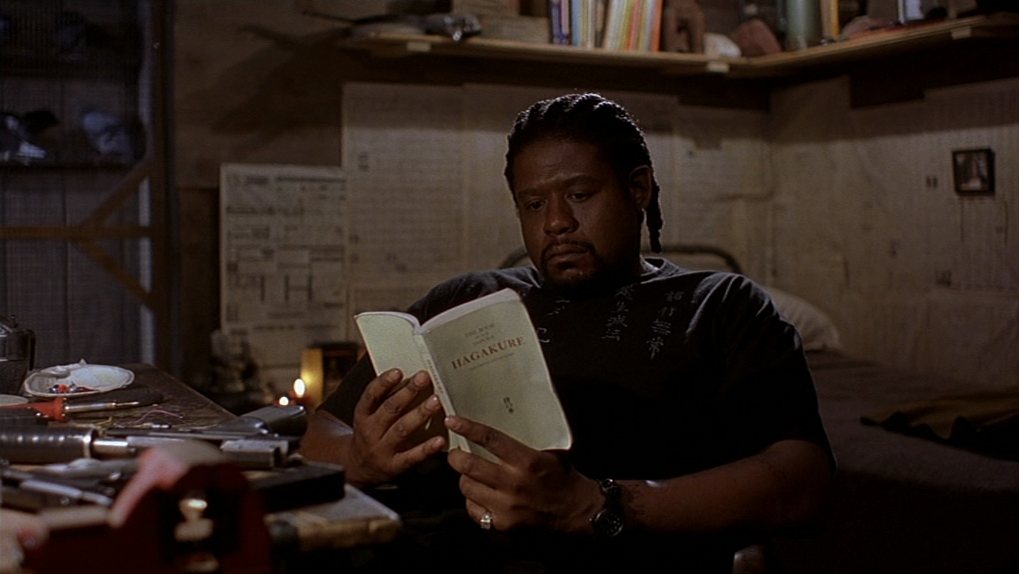
When the mob decides to have him killed, Ghost Dog kills the men who gave the order, one after another, but he will not kill Louie, because a retainer cannot kill his lord. At the end he walks out to meet Louie in the street with an empty gun and lets Louie shoot him. Among the films Jarmusch had given Whitaker to prepare were Seven Samurai, Seijun Suzuki’s Branded to Kill and Shogun Assassin. Jarmusch explained the ending in terms Tsunetomo would have recognized: “Death is not a problem for Ghost Dog. What would be a problem is if he had stayed alive and compromised his code.”Stephen Ashton, “Conversation with Jim Jarmusch: Cinematic Samurai,” MovieMaker, an interview recorded at the Toronto International Film Festival in 1999. But the film is on the side of the man rather than the code. The gangsters he serves are a comic portrait of a code gone to rot, old men in a back room watching cartoons. “Their code has totally unraveled and so they’re a mess,” Jarmusch said. “Their power has been usurped by corporate crime.” Ghost Dog’s only friend, Raymond, a Haitian ice-cream seller, speaks only French, and Ghost Dog speaks only English, and they understand each other perfectly. “Me and him,” Ghost Dog says of Louie, “we’re from different ancient tribes. And now, we’re both almost extinct.” The retainer’s virtue is real. Its object is not worthy of it.
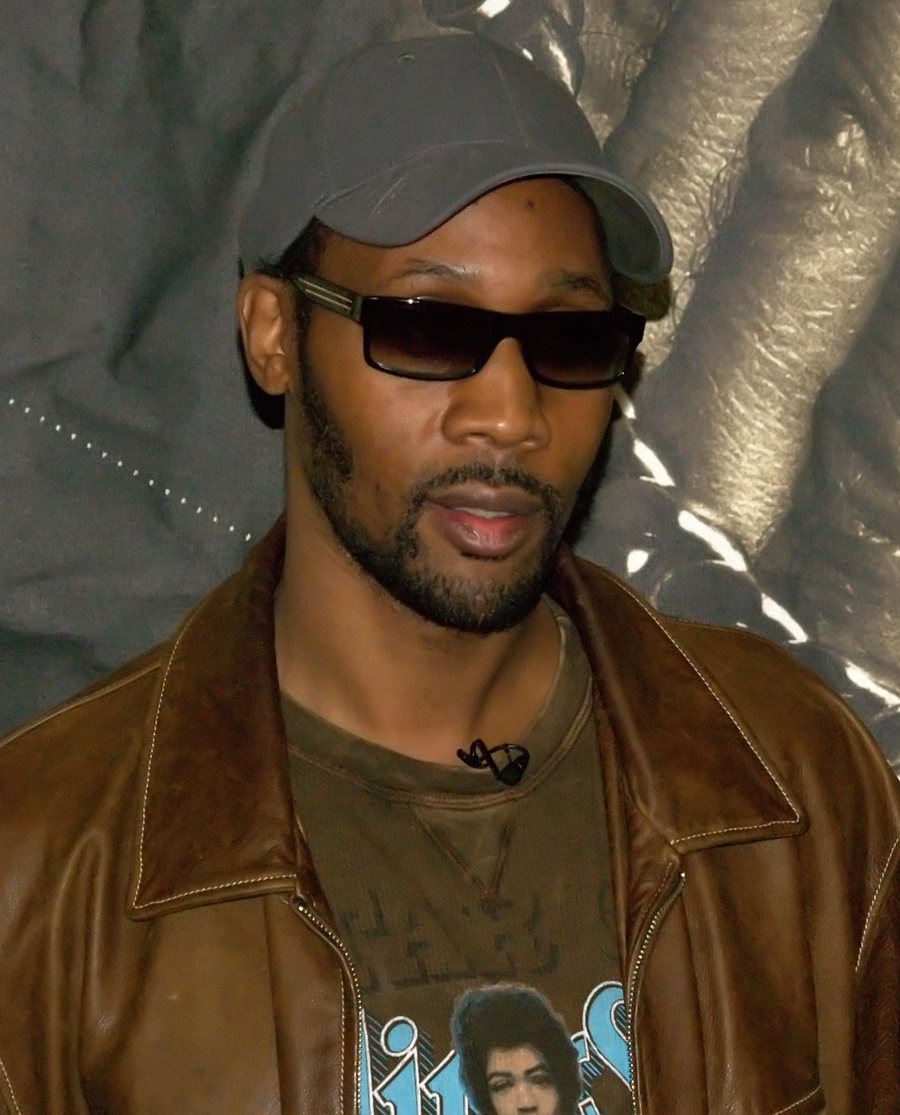
Why should a Black man in New Jersey live by an eighteenth-century Japanese book? Jarmusch thought he was drawing on something real: “the Eastern pull on young urban black people is amazing, very, very strong. I think if you are young and black it’s dangerous to make the identification with Africa because that becomes political… So they gravitate toward the East… which also comes from the accessibility of martial arts films in urban areas.” Scholars have traced that pull back to the kung fu films that filled inner-city cinemas in the 1970s, when Bruce Lee was a hero in Black neighborhoods across the United States. The historian Vijay Prashad argues that “kung fu gives oppressed young people an immense sense of personal worth and the skills for collective struggle.”Vijay Prashad, “Bruce Lee and the Anti-imperialism of Kung Fu: A Polycultural Adventure,” positions 11, no. 1 (2003): 51–90, p. 74; a longer version of the last chapter of his Everybody Was Kung Fu Fighting (2001). See also Amy Abugo Ongiri, “‘He Wanted to Be Just Like Bruce Lee’: African Americans, Kung Fu Theater and Cultural Exchange at the Margins,” Journal of Asian American Studies 5, no. 1 (2002): 31–40. The film’s score is by the RZA of the Wu-Tang Clan, whose records are built from samples of martial arts films, and who appears for a moment as a samurai in camouflage. His bandmate GZA opened his album Liquid Swords (1995) with the voice of the small boy in Shogun Assassin: “When I was little, my father was famous. He was the greatest samurai in the empire. And he was the Shogun’s decapitator.” In The Tao of Wu (2009), RZA describes New York hip-hop in 1986 as a war: “As a man is becoming a samurai, he roams the country in search of opponents. And as an MC, you did the same thing.” The wandering swordsman, testing himself in duel after duel, has become the battle rapper.
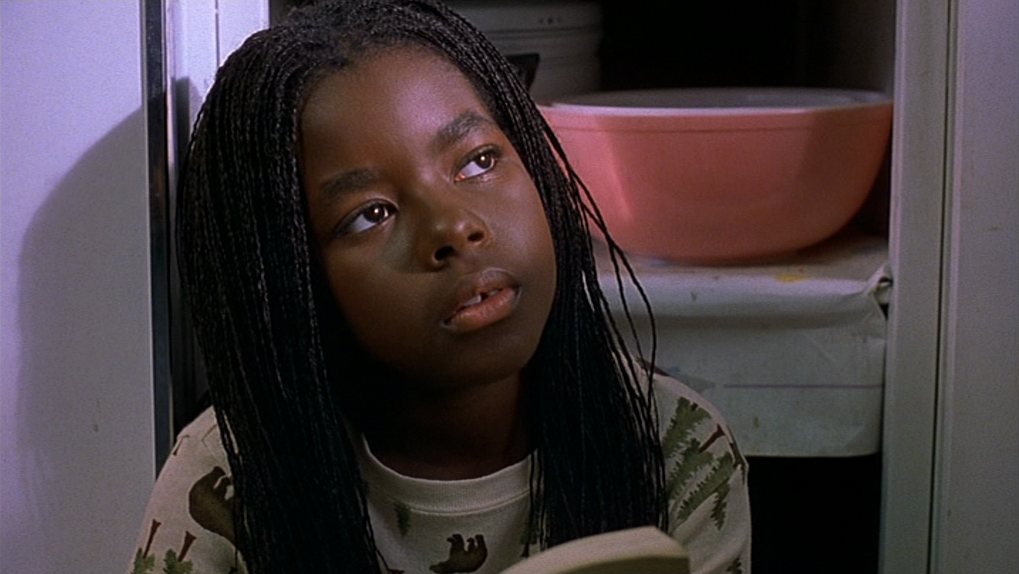
The critic Greg Tate, writing for the Criterion Collection, admired the film and also named its problem: “Ghost Dog’s denouement shows a noble Black man sacrificing himself for a white man,” and it confirms Jarmusch’s “fascination with the alienated and self-distancing American male way of death.”Greg Tate, “Ghost Dog: By the Book,” Criterion Collection essay, 2020. I think Tate is right, and I think the film half knows it, because its last scenes argue with the death it has prepared. Ghost Dog has lent a young girl in his neighborhood, Pearline, his copy of Rashōmon, the stories by Akutagawa from which Kurosawa made his film about four witnesses who give four irreconcilable accounts of a killing. “It’s one story,” she tells him, “but each person sees a totally different story.” Dying, he gives the book to Louie: “You take this book… and read it some time.” He has already given Pearline his Hagakure, telling her, “You don’t gotta read it right away.” In the last scene she picks up his empty gun, and the film’s last passage from the book is read in her voice: “The end is important in all things.” It hands the code to the next generation, a Black girl, together with a book whose whole point is that every story can be read in another way. It ends, that is, as an argument about interpretation.
Champloo
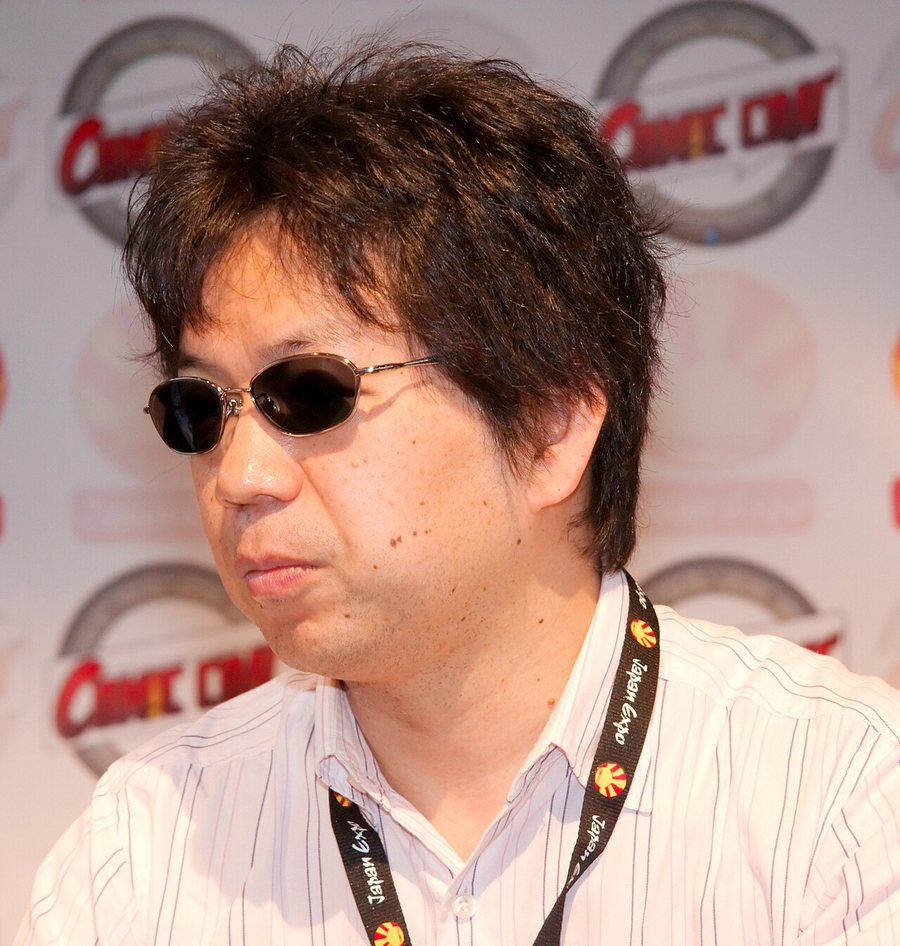
Shinichirō Watanabe’s anime series Samurai Champloo (2004–05) takes the opposite road. Champloo comes from the Okinawan chanpurū, a stir-fry of whatever is at hand, and Watanabe used it to mean “something mixed”: “I combined two completely different elements, a traditional samurai story and trendy hip-hop music.” His Edo period is full of graffiti, beatboxing and baseball, and its soundtrack is by the Japanese producer Nujabes, the American Fat Jon and others. Its three heroes are a girl, Fuu, who is looking for “the samurai who smells of sunflowers,” and two swordsmen she has talked into escorting her, who would rather kill each other. Jin is a rōnin of the old school, quiet, bespectacled and formally dressed, who fights in the classical style; we learn near the end that he is masterless because he killed his own teacher, who had been ordered to kill him. Mugen is an outlaw from the Ryukyu Islands, which in the Edo period were not even part of Japan but a separate kingdom under the domination of Satsuma. He grew up on a penal island, fights like a breakdancer, and belongs to no class at all. When Watanabe came up with him, he said, “I heard hip-hop at the same time, and I thought he was going to be a rapper samurai.”Watanabe, interviews with Macross World (Anime Festival Asia, 2012) and EasternKicks (2015).
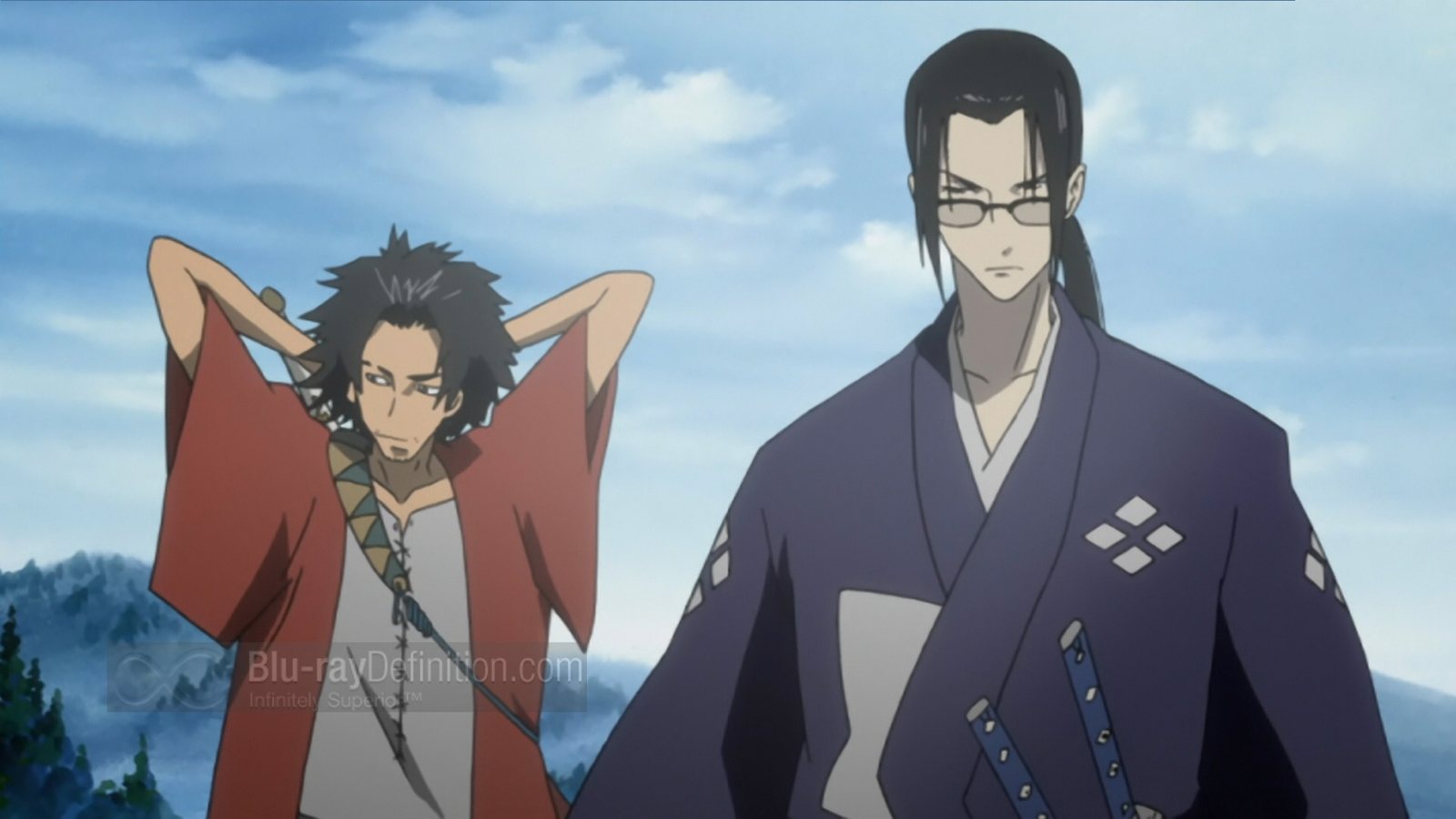
Fuu’s search is a search for her father. The sunflower samurai turns out to be Kasumi Seizō, a Christian samurai said to have been among the leaders of the Shimabara rebellion, who left his family long ago; Fuu wears a cross. When she finds him he is dying of an illness, and an assassin sent by the shogunate kills him. In the last episode Mugen and Jin finally fight each other, and both their swords shatter. Neither dies. Fuu admits that she rigged the coin toss that bound them to her in the first episode, and the three go their separate ways. The final arc carries the Buddhist title Shōji ruten, the endless turning of birth and death, and its theme song, Nujabes’s “Battlecry,” keeps the old fatalism as a refrain: “Some days, some nights, some live, some die / In the way of the samurai.” But the series lets its men live. In the Oedipal plot of so many samurai stories, the son finds the father in order to kill him or to die avenging him. Here the father is found and lost, and the two young men who were supposed to kill each other become friends instead.
Afro Samurai (2007) comes from the other direction, as a Japanese artist’s homage to Black America. Takashi Okazaki, who began drawing it as a self-published manga at the end of the 1990s, grew up on hip-hop, soul and reruns of Soul Train. In Japan, he remembered, the afro was treated as a joke, and he wanted to show how cool it was; as “a Japanese person who loves afros and jidaigeki,” he wanted to play back to Americans their own “slightly mistaken view of Japan.”Interview with Okazaki in Cinema Factory, October 2007; my translation. The animated series, made by the studio Gonzo with Samuel L. Jackson as the voice of Afro and music by the RZA, premiered on American cable television before it was shown in Japan. Its world is a machine built out of the death drive. Whoever wears the Number One headband is a god, but only the wearer of the Number Two headband may challenge him, and anyone may challenge Number Two. Afro’s father was Number One, and Afro as a child saw him killed by the man who took his headband. Afro now wears Number Two, so he spends his life being attacked by everyone who wants to rise, and kills his way through them toward a revenge that would only make him the next target. I know of no more literal picture of the compulsion to repeat. Afro barely speaks. He is followed everywhere by a talkative companion, Ninja Ninja, also voiced by Jackson, who turns out to exist only in Afro’s head: the voice of everything the silent swordsman keeps down.
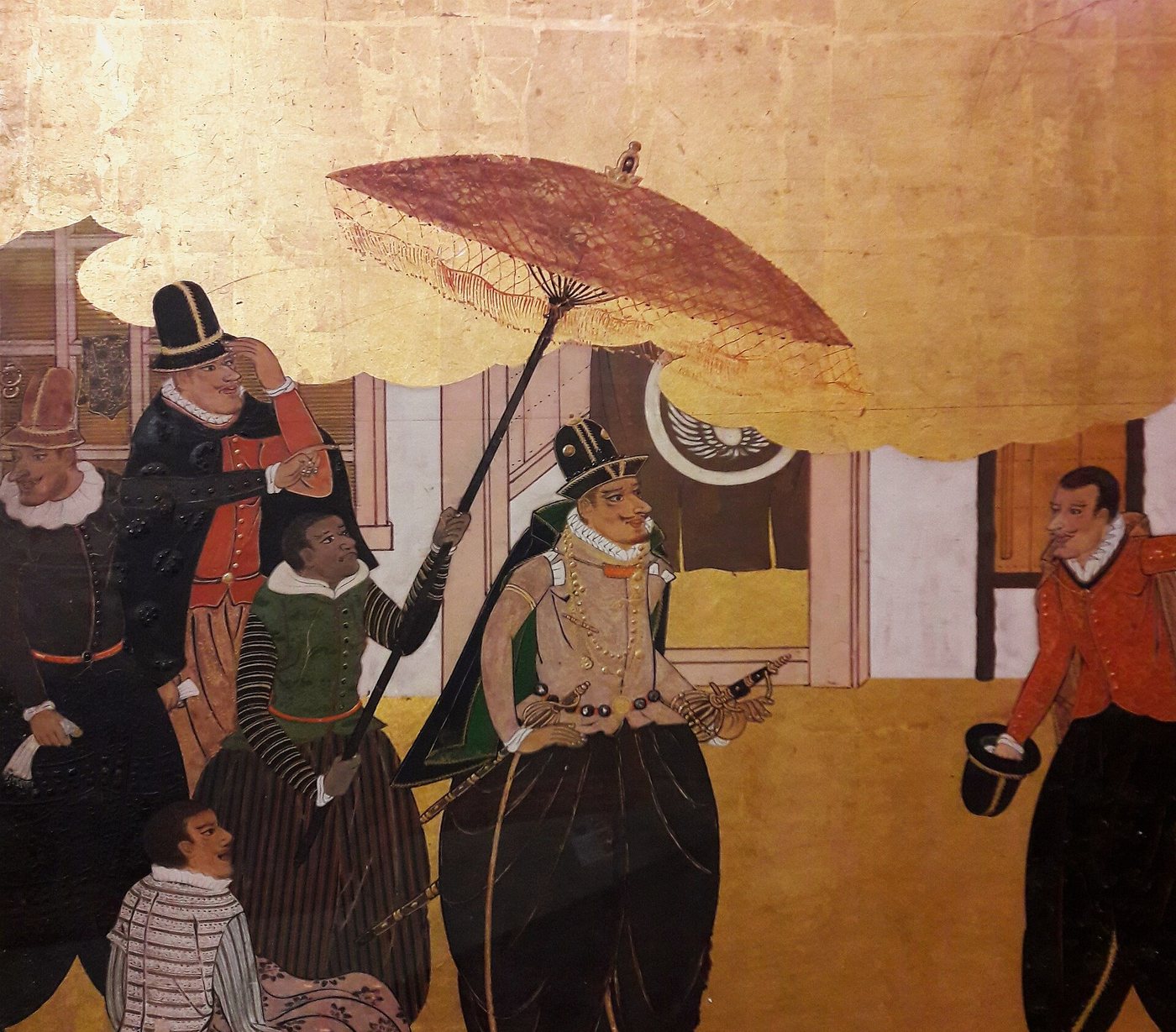
Behind all three stands a historical figure who has recently become a battleground. In 1581 an African man came to Kyoto with the Jesuits and was presented to the warlord Oda Nobunaga. Nobunaga’s chronicler recorded that he looked “twenty-six or twenty-seven years old,” was “black over his whole body,” and had a strength that “surpassed that of ten men,” and one version of the chronicle adds that Nobunaga gave him a stipend, a house, a sword and the name Yasuke, and that he sometimes carried his lord’s weapons. A Japanese lord who saw him in 1582 wrote in his diary that “his body was black like ink.”Ōta Gyūichi, The Chronicle of Lord Nobunaga, trans. J. S. A. Elisonas and J. P. Lamers (2011), pp. 385–86; the diary of Matsudaira Ietada, 1582. He was with Nobunaga at the Honnōji temple when Akechi Mitsuhide’s troops attacked in 1582, and according to a Jesuit report Akechi spared him on the ground that he was not Japanese. No contemporary source calls him a samurai, and historians disagree about whether the grants he received amounted to samurai status. In the last few years he has been the hero of a Netflix anime, Yasuke (2021), and of a video game, Assassin’s Creed Shadows (2025), whose announcement set off a long and bitter argument online, conducted mostly by men, about whether a Black man could be called a samurai. The argument was about a word, and about who has a right to the kind of manhood the word has come to stand for, which is to say, about the subject of this essay.
The Best Sword Is Kept in Its Sheath
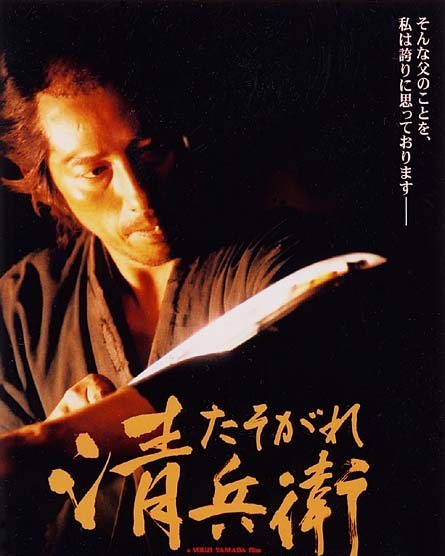
Yamada Yōji’s The Twilight Samurai (2002) is the film I would put at the end of this history. Its hero, Iguchi Seibei, played by Hiroyuki Sanada, is a low-ranking clerk in the granary of a small northern domain at the end of the Edo period. His colleagues call him “Twilight” because instead of drinking with them he goes home every day at dusk to look after his two small daughters and his senile mother. He sold his good sword to pay for his wife’s funeral and carries a bamboo blade, like Motome in Harakiri. When the clan orders him to kill a retainer who has refused to commit seppuku, he goes reluctantly, and wins with his short sword. Nothing in the film is heroic in the old way, and it is the most moving samurai film I know. Its narrator is his younger daughter, grown old, who tells us that a few years later he was killed in the war that ended the shogunate, on the losing side. She does not tell us that his death was beautiful. She says that he must have lived his short life content, and that she is proud of a father like that.
Looking back over this history, the films I admire most share a single gesture. A man gives up something the code says he cannot live without, and lives. Kanbei shaves his head to save a child. Sanjūrō tells the young men to stay in their sheaths. Seibei goes home at dusk. Mugen and Jin break their swords on each other and walk away. Even Ghost Dog, which lets its hero die, ends by handing the book to a reader who can read it differently. The code says that a man who has lost his topknot, his sword or his lord must die, because otherwise he is not a man. The films answer that a man is exactly the one who can lose these things and go on.
Freud understood the attraction of the risk. In 1915, a few months into the First World War, he wrote that life “is impoverished, it loses in interest, when the highest stake in the game of living, life itself, may not be risked.” That sentence describes very well what drew me to the ring. But he ended the same essay by rewriting an old Latin proverb. Instead of “If you want peace, prepare for war,” he proposed: “Si vis vitam, para mortem. If you want to endure life, prepare yourself for death.”“Thoughts for the Times on War and Death” (1915), Standard Edition 14:290 and 300. That is Hagakure’s daily meditation on death turned the right way round, as an exercise for the sake of living, and I think it is what Tsunetomo himself, an old man who liked to sleep, actually practiced. It is also what I would take from the rainstorm passage now. Resolve to be soaked, and walk on through the rain.
I read Hagakure too early, and I read the half of it that was written for young men. When Ghost Dog gives his copy to Pearline, he tells her she doesn’t have to read it right away. I think that is good advice.
Frames from Harakiri (© Shochiku, from the Criterion Blu-ray), Ghost Dog: The Way of the Samurai and Samurai Champloo and the DVD jacket of The Twilight Samurai are reproduced at reduced size for criticism and commentary; their copyrights belong to their owners. The other images are in the public domain or under the Creative Commons licenses named in their captions.