The Geometry of Love
Anne Carson draws desire as a triangle whose third point holds lover and beloved apart. Following her back to Sappho and Plato, this essay traces the shapes love draws in space and in time, and asks whether there is a love that is neither lack nor pure gift.

Eros once again limb-loosener whirls me / sweetbitter, impossible to fight off, creature stealing up
Anyone who has waited for a message knows the shape of the evening it makes, the phone turned face down and then face up again, the last conversation replayed until every pause in it seems to mean something, and the beloved growing larger in absence than they ever were in the room, so that when they finally arrive, and the waiting is over, the fever that filled the evening sometimes cools into something quieter and more puzzling, as though what we had wanted all along was not quite the person who is now sitting across from us. Out of this experience comes a piece of wisdom that sounds like disillusion: love is desire, and desire is lack, so that we can only love what we do not have, and love must die of its own success. If that is true, then the only love that could last would be a love that lacks nothing and therefore wants nothing, the self-giving love the Christian tradition calls agape or the 慈悲 of the bodhisattva, which pours itself out on every creature and asks for nothing in return, and between the fever that burns out and the charity that asks for nothing, the ordinary love of two people for each other would have nowhere to stand.
The most beautiful account of the first half of this wisdom is Anne Carson’s Eros the Bittersweet, a short book by a poet who is also a classicist, which reads Sappho and Plato in order to ask what desire is, and which answers, with the Greeks, that desire is the wanting of what is missing: “Who ever desires what is not gone? No one. The Greeks were clear on this. They invented eros to express it.” The Greek word is worth keeping in Greek, for eros is narrower than our “love”: it means wanting, and Homer can use it for an appetite for food and drink, so that Carson’s book is about desire in the strict sense, and the question it leaves us with is whether love is nothing more than that. Satie’s Gymnopédie, which he marked lent et douloureux, slow and sorrowful, sounds like the condition the book describes, a melody that rises and sinks over a rocking accompaniment without ever arriving anywhere, sweet and sad in the same breath. In what follows I trace the shapes that love draws, first as desire and then beyond it, as Carson does when she calls a poem of Sappho’s a triangle, following them through the line, the triangle, the reach, the collapse and the ladder, and then into time, where a single moment can echo through a whole life, until we reach a figure that the Greek sources contain but Carson leaves aside, a love that is neither lack nor pure gift.
Three Points
Carson begins with a single word of Sappho’s, glukupikron, which we translate as “bittersweet” although Sappho put the sweet first, and Carson argues that the order does not describe a love affair that starts in sweetness and ends in bitterness, as so many do, but a single instant in which both arrive together: “A simultaneity of pleasure and pain is at issue.” The lover feels the beloved’s beauty as sweetness and, in the same moment, feels as bitterness that this beauty is not their own, and the two cannot be pulled apart, because the beloved is desirable partly in being out of reach. “The Greek word eros denotes ‘want,’ ‘lack,’ ‘desire for that which is missing,’” Carson writes, and then draws the consequence with a logician’s calm: “The lover wants what he does not have. It is by definition impossible for him to have what he wants if, as soon as it is had, it is no longer wanting.”
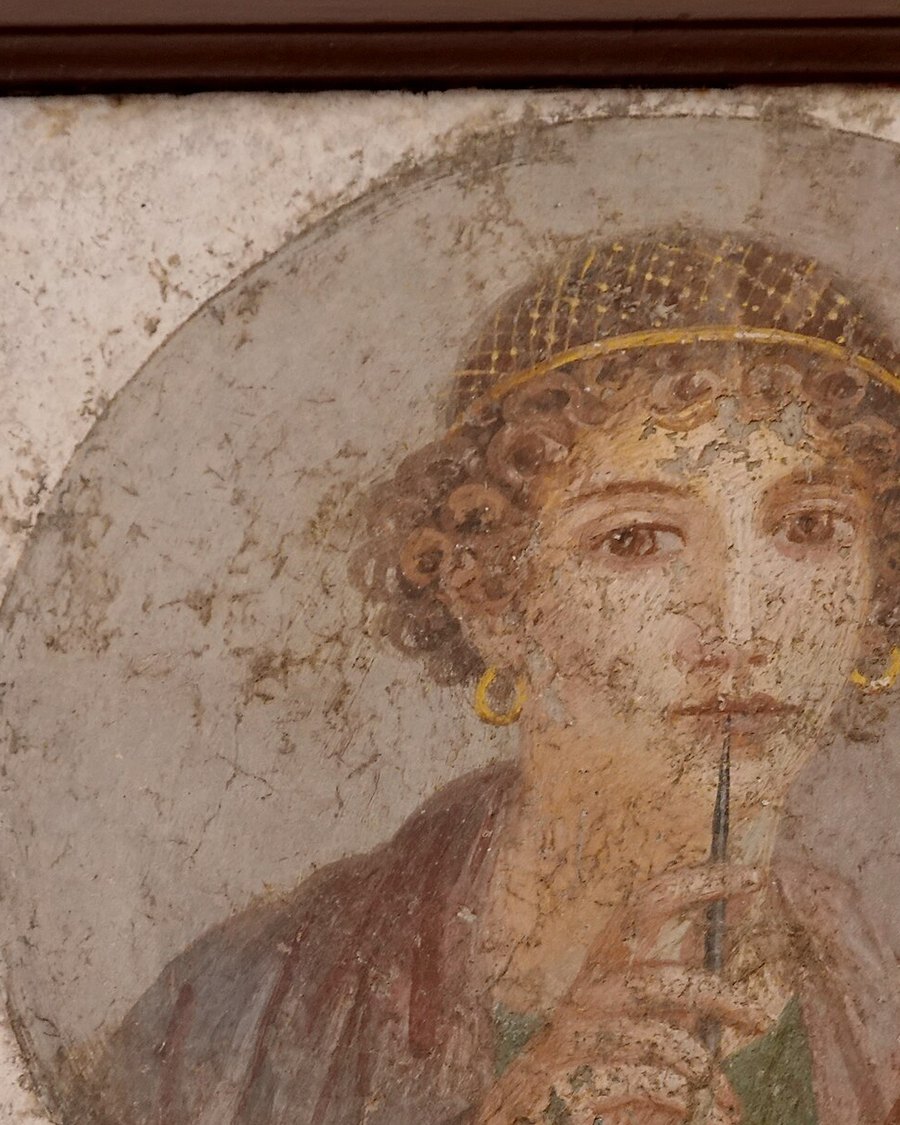
The poem from which Carson draws her geometry is Sappho’s fragment 31, in which a man sits opposite the woman the poet loves and listens close to her sweet speaking and lovely laughing, while the poet, watching the two of them, comes apart: “no: tongue breaks, and thin / fire is racing under skin / and in eyes no sight and drumming fills ears”. Readers have long taken the poem for a confession of jealousy, but Carson reads it as something stranger and more exact: “It is not a poem about the three of them as individuals, but about the geometrical figure formed by their perception of one another, and the gaps in that perception.” The figure is a triangle, and the triangle is not an accident of this poem but the shape of desire itself, for “where eros is lack, its activation calls for three structural components—lover, beloved and that which comes between them.” The third point holds the other two together by holding them apart, and Carson’s description of it has the charge of the thing it describes: “They are three points of transformation on a circuit of possible relationship, electrified by desire so that they touch not touching. Conjoined they are held apart.”
We usually draw a couple as two points and a line between them, but desire, if Carson is right, draws three, and the third need not be a rival like Sappho’s listening man, since anything that stands between the lover and the beloved will serve, a distance, a husband or a wife, a difference of age or station, the beloved’s indifference, the ocean between two cities, or the small screen that does not light up when we want it to. What the third point does is double: it keeps the two apart, and in keeping them apart it keeps desire alive, and through the gap it opens the lover sees not only the beloved but the beloved transfigured, for, as Carson writes of Sappho’s poem, “The ideal is projected on a screen of the actual,” so that the man sits like a god and the poet almost dies, and both are true at once in the same desiring mind. The triangle is the place where love first learns to imagine, and where it first learns to mistake what it imagines for the person in front of it.
The Reach
Carson ends her reading of Sappho’s poem with three short sentences that turn its geometry into a motion, “For in this dance the people do not move. Desire moves. Eros is a verb,” and indeed the shape desire draws is less a figure than a gesture, a reaching toward something that recedes as one reaches, like the sweet apple in another fragment of Sappho that reddens on the highest branch, which the apple-pickers did not forget but could not reach, and from which Carson draws the whole law of the reach: “beautiful (in its object), foiled (in its attempt), endless (in time).” The curve of such a reach is an asymptote, a line that comes nearer and nearer to another without ever meeting it, and the lover who lives along it comes to love the nearing more than any arrival it promises, which is why, as Carson says, “Lovers are always waiting. They hate to wait; they love to wait.”
This is the poet’s love, and Carson, who is a poet, is candid about where its gaze finally falls: “Who is the real subject of most love poems? Not the beloved. It is that hole.” The beloved, seen across the gap, becomes the occasion of an image, and the image becomes the true object of the lover’s devotion, for “On the surface of it, the lover wants the beloved. This, of course, is not really the case.” What the lover wants, Carson argues, is the current that passes when the actual self and the imagined self and the difference between them light up together in one triangle: “The connection is eros.” Desire, in this account, is a story the lover tells, and Carson says so in so many words: “Eros is always a story in which lover, beloved and the difference between them interact. The interaction is a fiction arranged by the mind of the lover.”
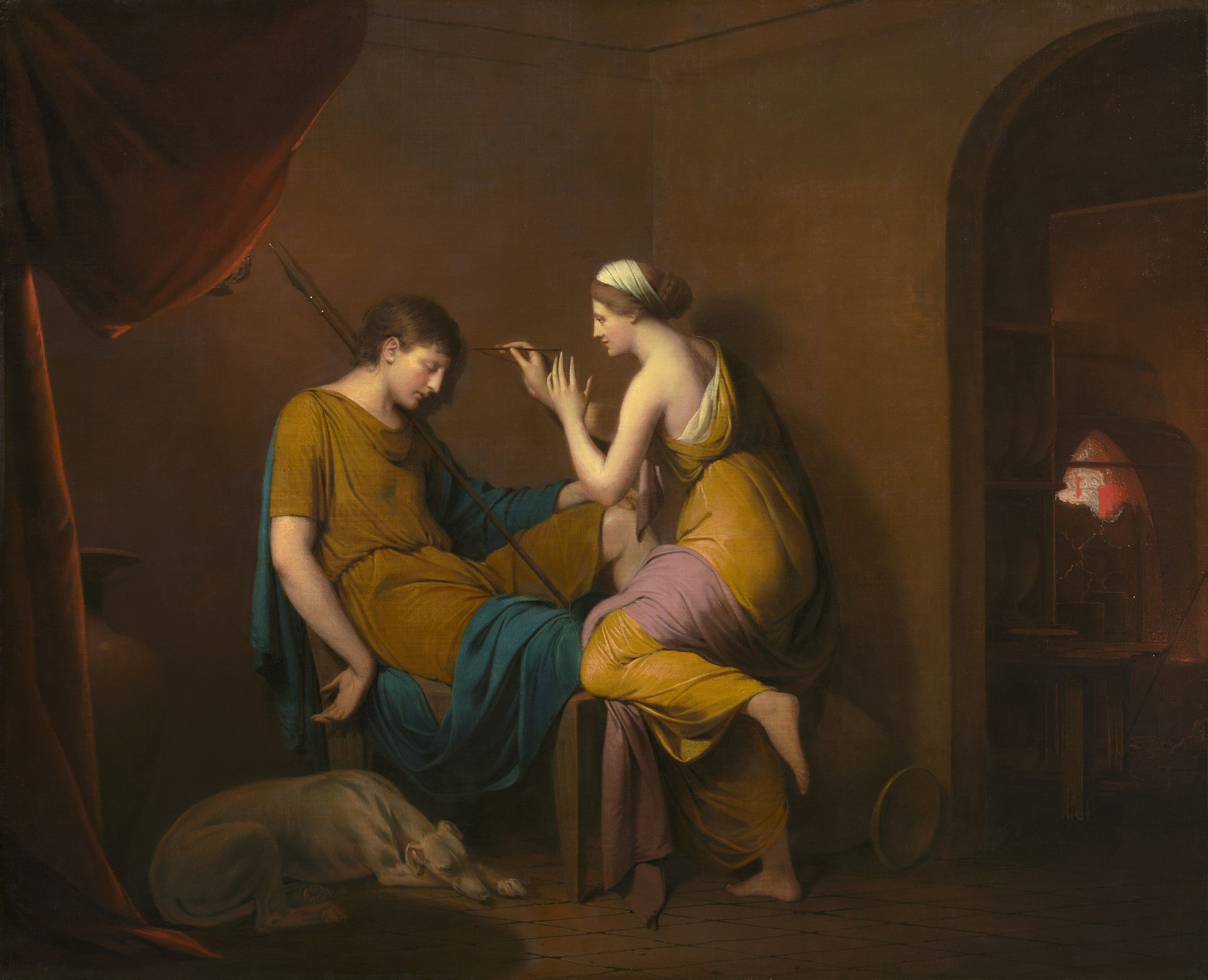
Pliny the Elder tells a story about the first portrait that could serve as a parable of this love, in which the daughter of a potter working at Corinth, “being deeply in love with a young man about to depart on a long journey, traced the profile of his face, as thrown upon the wall by the light of the lamp,” so that something of him would remain when he was gone, and Joseph Wright painted her at the moment of tracing, the young man asleep beside her and her whole attention given not to him but to his shadow. The outline she draws will outlast his presence, and in the long evenings after he leaves it may become dearer to her than the man himself, since an outline never disappoints and never changes, and this is the risk the poet’s love runs, of loving the shadow on the wall because it stays.
From here it is a short step to the strangest claim in Carson’s book, which is that lovers, like writers, keep the obstacle in place on purpose, since an obstacle removed is a story ended: “The unknown must remain unknown or the novel ends. As all paradoxes are, in some way, paradoxes about paradox, so all eros is, to some degree, desire for desire. Hence, ruses.” The troubadours who sang of love from a distance knew this, and so does anyone who has prolonged an uncertainty because certainty would have asked something of them, and the figure of such desire is no longer a line that approaches but a circle that returns, a reach that keeps coming back to its own beginning so as never to be done.

Satie’s first Gnossienne is the sound of that circle, for he wrote it without bar lines, so that the melody is never told where its measures begin or end, and he scattered through the score directions that no metronome can obey, asking the player to play “very shiny”, to “question”, to play “from the tip of thought”, while the melody turns and turns about the same few notes, as though looking for something it has decided not to find.
In Plato’s Symposium the poet’s love has a spokesman, for the banquet is held at the house of Agathon, a young tragic poet celebrating his first victory, and when his turn comes to praise Eros he paints the god as the youngest, softest and most beautiful of all, “the most blissful, as being the most beautiful and the best.” It is a lovely speech, and it is a projection of the kind Carson describes, for Agathon has painted Eros in the likeness of the beloved, giving desire all the beauty of what it desires, and it falls to the philosopher to ask whether a desire can possess what it longs for. Before we follow his question, however, we should ask what becomes of the poet’s triangle when the third point is taken away.
Line and Point
If the lover wants only what is missing, then the beloved who is finally won can no longer be wanted, and the triangle, robbed of its third point, falls into a line, which then begins to slacken, as the god who sat opposite becomes a person who forgets to call and leaves the dishes for the morning, and the current that ran between three points has nowhere to go between two. The old complaint that marriage is the grave of love says nothing more than this, and Carson, who knows that the lover dreads the moment of having even as he reaches for it, describes the bind exactly: “As lover you reach forward to a point in time called ‘then’ when you will bite into the long-desired apple. Meanwhile you are aware that as soon as ‘then’ supervenes upon ‘now,’ the bittersweet moment, which is your desire, will be gone. You cannot want that, and yet you do.”
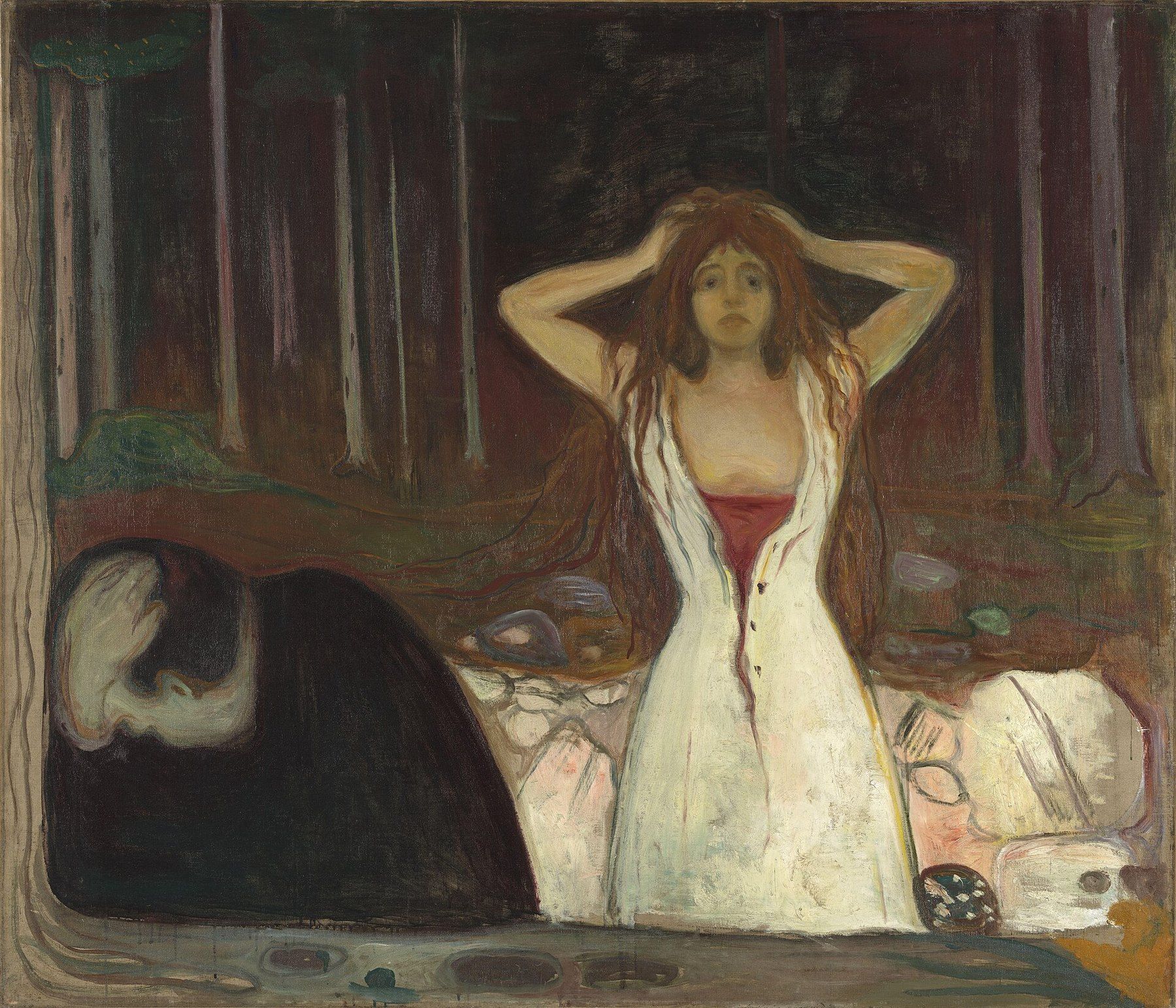
Edvard Munch painted the moment after, a man sunk into himself with his face hidden and a woman standing above him with her hands in her hair, the two of them together and further apart than any distance could have made them, and the title he gave it is Ashes. Yet the line that slackens is only one of the two ways the triangle can collapse, for the lovers may instead try to abolish the distance altogether, not by possessing the beloved but by becoming one with them, and this is the figure that Aristophanes draws in the Symposium, where human beings were once round, with four arms and four legs, until Zeus cut each of them in half, so that each of us now goes about searching for the other half we lost. Aristophanes notices that the lovers who find each other cannot say what they want, the soul of each “wishing for something else that it cannot express, only divining and darkly hinting,” and when the smith god Hephaestus stands over them with his tools and offers “to fuse and weld you together in a single piece, that from being two you may be made one … and that when you die you may also in Hades yonder be one instead of two, having shared a single death,” no lover, Aristophanes says, would refuse.
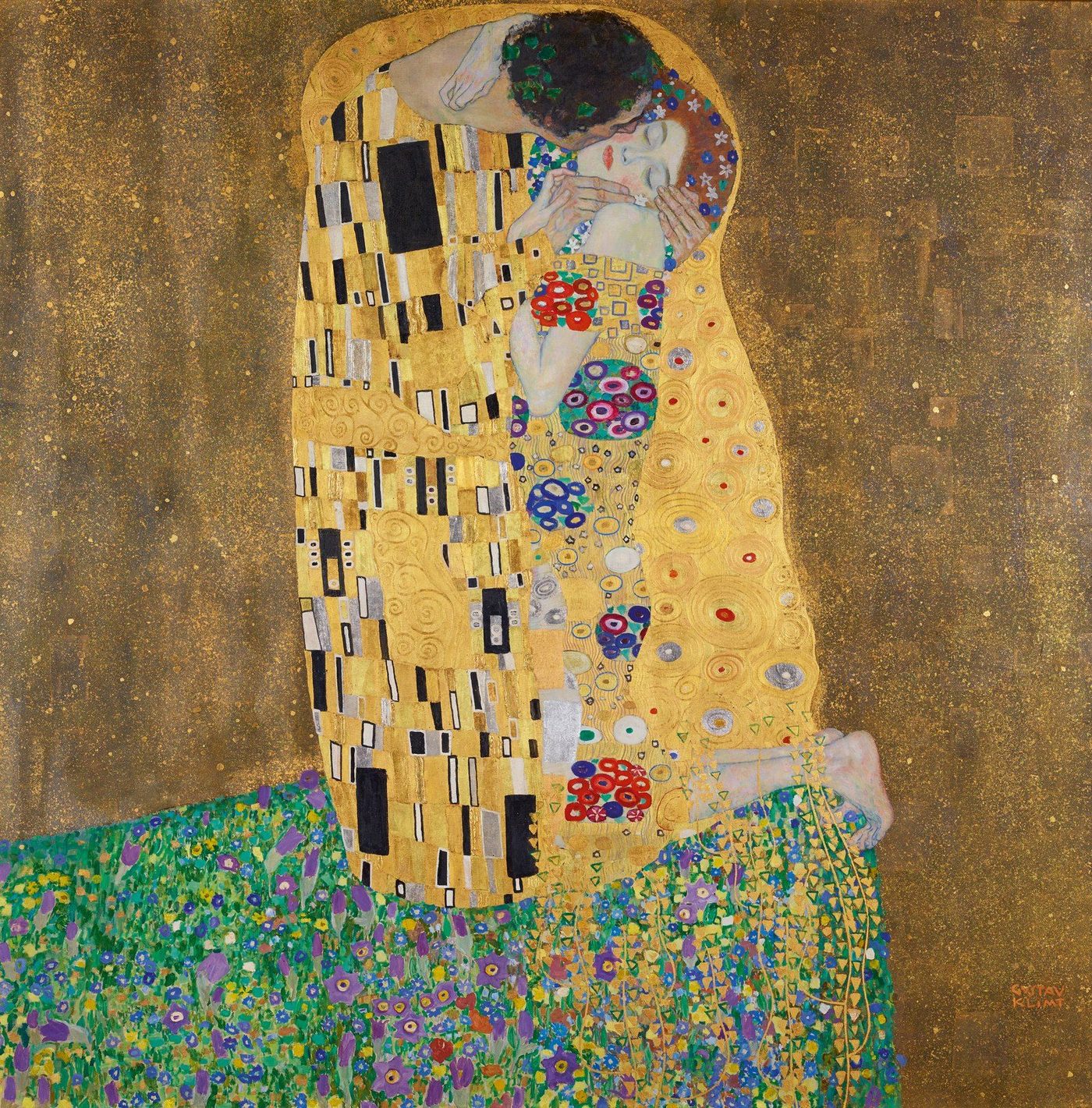
Gustav Klimt gave this desire its most famous image, two lovers so wrapped in a single golden robe that only their faces and hands remain their own, on a meadow of flowers that ends, just beneath her knees, at the edge of nothing. Carson says plainly what the edge means, for in Sappho’s poem, she writes, “Union would be annihilating,” and Wagner’s Tristan und Isolde, which I have written about elsewhere as the great drama of love’s night, carries this logic to its end, since its lovers can find no union in the daylight world and seek it in a night that is finally death, where there would no longer be a Tristan and an Isolde but only the one thing that loves.
If love is desire and desire is lack, then love has only these two endings, the line that slackens into boredom and the point that closes into death, and it is here, rather than in desire itself, that desire becomes a perversion of love. Desire is not perverse because it wants, nor even because it imagines, since every love begins in an image; it turns against love when the lover comes to prefer the gap to the person, so that the beloved is wanted only so long as they are withheld, and the obstacle that once revealed them becomes the true object of devotion, as when a ruse that was meant to keep a story going is made into a destiny that ends it.
The Ladder
When Agathon has finished, Socrates asks him a few simple questions, and the poet who painted Eros as the most beautiful of gods is led, step by step, to agree that whoever desires something does not have it, “not as a likelihood, said Socrates, but as a necessity, consider if the desiring subject must have desire for something it lacks, and again, no desire if it has no lack.” If Eros desires beauty, then Eros lacks beauty and cannot be beautiful, and Agathon, to his credit, concedes the whole speech: “I greatly fear, Socrates, I knew nothing of what I was talking about.” This is the oldest argument for the thesis that love is lack, and it is made by the philosopher against the poet, but Socrates slips into it a qualification that is easy to miss, for when he raises the case of a healthy man who wishes to be healthy, he explains that such a man desires something he does not yet have, namely that his health continue: “I wish these things now present to be present also in the future.” Desire, on this account, can be for what we already have, provided that what we lack is its future, and we will need this small concession at the end.
Socrates then hands the argument to a woman who, he says, taught him the art of love, the priestess Diotima, who tells him that Eros is the child of Resource and Poverty, conceived at the feast for Aphrodite’s birth, and so is neither a god nor a mortal, neither wise nor ignorant, but something between, a spirit who is always poor and always scheming after what is beautiful. Because the gods are already wise and the ignorant do not know what they lack, it is the ones between who seek wisdom, and among them is Eros: “For wisdom has to do with the fairest things, and Love is a love directed to what is fair; so that Love must needs be a friend of wisdom, and, as such, must be between wise and ignorant.” The word for a friend of wisdom is philosophos, built not on eros but on philos, “fond of” or “given to”, so that the lover in Diotima’s speech turns out to be a philosopher in the plain sense of the word, someone who knows what they lack and makes that knowledge into a life. The poet loves the image he projects across the gap; the philosopher loves the gap itself, because he knows it is where he stands.
Diotima then says something that Carson’s book passes over, which is that love, as she tells Socrates, is not “the love of the beautiful only” but “the love of generation and birth in beauty,” since all human beings are pregnant “both in body and in soul” and long to bring forth what they carry in the presence of something beautiful. With this the account of desire as lack turns over, for lack, which looked like a hole, turns out to be a fullness waiting to be born, and Diotima counts the poets among the pregnant, Homer and Hesiod with their immortal children, while lovers who bring forth wisdom and virtue together, she says, share “a far surer friendship” than parents who share only children of the body.
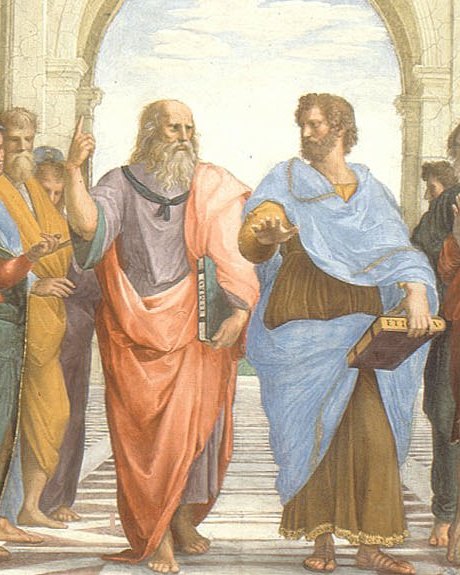
The speech ends on its most famous image, the ascent by which the lover rises from loving one beautiful body to loving all beautiful bodies, then beautiful souls, then laws and ways of life, then knowledge, until he suddenly sees beauty itself, climbing, in Diotima’s words, “as on the rungs of a ladder.” Raphael painted Plato pointing up that ladder, and the gesture is the philosopher’s love in a single line, but the ladder has a price, which is that the beloved person stands on its lowest rung and is loved as the occasion of an ascent that leaves them behind. Carson ends her book, fittingly, with Socrates, in sentences that turn the philosopher back into a lover of the reach and give the reach its proper name: “It is a high-risk proposition, as Sokrates saw quite clearly, to reach for the difference between known and unknown. He thought the risk worthwhile, because he was in love with the wooing itself. And who is not?”
A Point in Time
The word risk sends us to another dialogue, the Phaedrus, which begins with a speech that Phaedrus carries under his cloak, in which the orator Lysias argues that a boy should give his favours not to a lover but to a non-lover, a man of sense who will not lose his head, will not be jealous and will have nothing to regret, and Carson sees that this is above all an argument about time. The lover is mad, and the sensible thing to do with madness, as she paraphrases Lysias, is to “Write him out of your novel,” so that Lysias “chooses to edit out ‘now’ and narrate entirely from the vantage point of ‘then,’” living as though every moment were already past and accounted for, and could change nothing in him. Socrates, after delivering a speech of the same kind with his head covered for shame, stops and recants, and his recantation begins by defending madness, since, in Carson’s rendering, “the greatest of good things come to us through madness when it is conferred as a gift of the gods,” and against the non-lover’s “then” it sets the lover’s “now”: “‘Now’ is a gift of the gods and an access onto reality. To address yourself to the moment when Eros glances into your life and to grasp what is happening in your soul at that moment is to begin to understand how to live.” Where Lysias edits the moment out, Socrates, in Carson’s words, “proposes instead to assimilate ‘now’ in such a way that it prolongs itself over the whole of life, and beyond.”
The moment Socrates has in mind is the one in which the lover sees a beautiful face and receives through his eyes a stream of beauty that warms and waters the roots of the soul’s lost feathers, so that they begin to swell and grow again, painfully and sweetly at once, like teeth cutting through the gums, and Carson, who reads this part of the dialogue with great tenderness, finds in it a different account of the same pain: “When you fall in love you feel all sorts of sensations inside you, painful and pleasant at once: it is your wings sprouting. It is the beginning of what you mean to be.” It matters that the wings grow from what flows in, rather than from a hole that aches to be filled, for love, in this telling, begins not in lack but in the reception of beauty, and it matters too that it begins in an instant, the same instant that Sappho records in her poem, “for when I look at you, a moment, then no speaking / is left in me,” and that Carson calls “a shaft sunk into time.”
Anyone who has lived a little knows that a life is not measured evenly, as clocks measure it, but gathers around a few such points, a glance across a room, an evening in which everything was said, a door that closed at the end of a love, moments that take no longer than any others and yet go on sounding for years, so that one may find oneself, decades later, still living inside their echo. Carson describes this from within the lover’s experience, where desire “seems to the lover to demolish time in the instant when it happens, and to gather all other moments into itself in unimportance,” but the moments that gather a life around them are not all happy ones, for a love that lasted a few months and ended badly can echo through forty years, and some echoes never fade, so that the instant which grows our wings may also leave a scar, and is very often the same instant.
Ravel’s Pavane pour une infante défunte, which he wrote in 1899 while still a student, has the shape of such a moment, a slow court dance from a vanished age whose opening melody comes back after each of two contrasting passages, altered a little each time, as a remembered moment comes back, never quite as it was and never quite gone. Ravel insisted that its title, a pavane for a dead princess, was chosen for nothing more than “the pleasure of alliteration,” and the piece is not a lament, yet it is hard to hear without thinking of what has passed and still sounds.
This is the risk that Carson names, and Socrates does not pretend it away, for falling in love, as she reads him, “gives you access to an infinite good. But it is also very clear that, when Eros impinges on you in his true form, something is lost, something hard to measure. When you fall in love you abandon the forms of ordinary life.” Lysias’s non-lover is safe precisely because nothing in his life will ever echo, and his time remains a line on which every point weighs the same, while the lover consents to let a single moment reorder all the others without knowing whether it will sound through the years as a blessing or as a wound, which is not a flaw in love but its condition, since a love that could not hurt us could never reach far enough into a life to matter. Some echoes run through time, however, and others run between two people, and the Phaedrus, having described the first, goes on to describe the second.
The Echo
It is here that the triangle begins to open, in a passage that Carson’s reading passes over and that I take to be the hinge of the dialogue, in which the stream of beauty that fills the lover overflows and turns back: “just as the wind or an echo rebounds from smooth, hard surfaces and returns whence it came, so the stream of beauty passes back into the beautiful one through the eyes,” where it waters the beloved’s feathers in turn and fills his soul with love. The beloved does not know what has happened to him, for “he sees himself in his lover as in a mirror, but is not conscious of the fact,” and Plato describes his state with a single verb used twice, once active and once passive, so that in his lover’s absence he both longs and is longed for. Then comes the sentence on which everything turns: “love’s image, requited love, dwells within him; but he calls it, and believes it to be, not love, but friendship.” The Greek word for this returned love is anteros, a counter-love or love-in-return, and the word the beloved finds for it is philia.
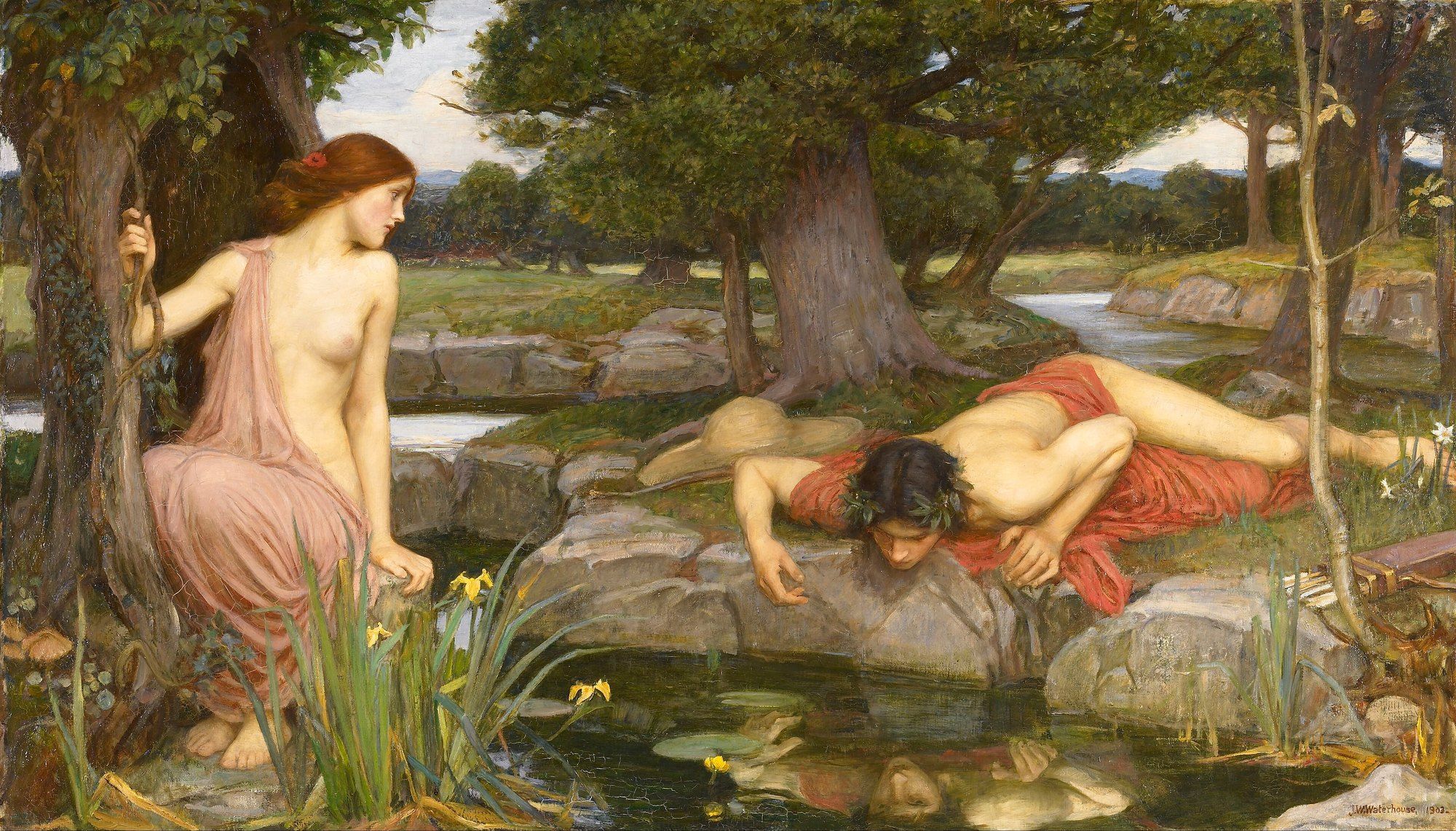
John William Waterhouse painted a story that reads like this passage turned inside out, Ovid’s tale of the nymph Echo, who can only repeat the last words spoken to her, and of Narcissus, who falls in love with his own face in a pool, so that the one loves a man who never answers and the other loves an image that answers only with himself. It is the poet’s fear in its purest form, that what comes back to us in love is only our own voice and our own reflection, and the Phaedrus, written centuries before Ovid, gives the same two images, the echo and the mirror, the opposite meaning, for what rebounds from the beloved is not the lover’s voice but the stream of beauty itself, and what the beloved sees in the mirror of his lover is himself as he is loved, which is the beginning of loving in turn.
What has happened to the triangle in this exchange is that its third point has not been removed, as when a lover wins and the line goes slack, nor fused away, as when two become one and die, but changed in nature, for the beauty that flows between the two no longer belongs to either of them and no longer runs in one direction only, and each of them is now both the lover and the beloved, wanting and wanted, reaching and reached. Desire has not died in this exchange, since the beloved still longs to see and touch his friend, but it has stopped being the desire of a hole for what is missing and has become the desire of two people for each other’s presence, and it is telling that when the Greeks had to name this returned eros, the word they reached for was the word for friendship.
The Open Triangle
Aristotle, who gave two whole books of his Ethics to friendship, makes the same move from the other direction, for friendship, in his account, is wishing the other’s good for the other’s own sake, and wishing it in return, and knowing that it is returned, since goodwill becomes friendship only “when it is reciprocal”, and the best friendships are between those who love each other for what they are, so that a friend becomes “another self”. Eros, in this light, is not the opposite of friendship but a form of it, “a sort of excess of friendship” that can be felt toward only one person, and Aristotle, who knew how often it fades, also knew how it can last: when the bloom of youth passes, he observes, some lovers part, “but many lovers on the other hand are constant, if familiarity has led them to love each other’s characters.” What holds such lovers together is not the gap between them but a life they share, which Aristotle finds in “their living together and sharing in discussion and thought; for this is what living together would seem to mean in the case of man, and not, as in the case of cattle, feeding in the same place.”
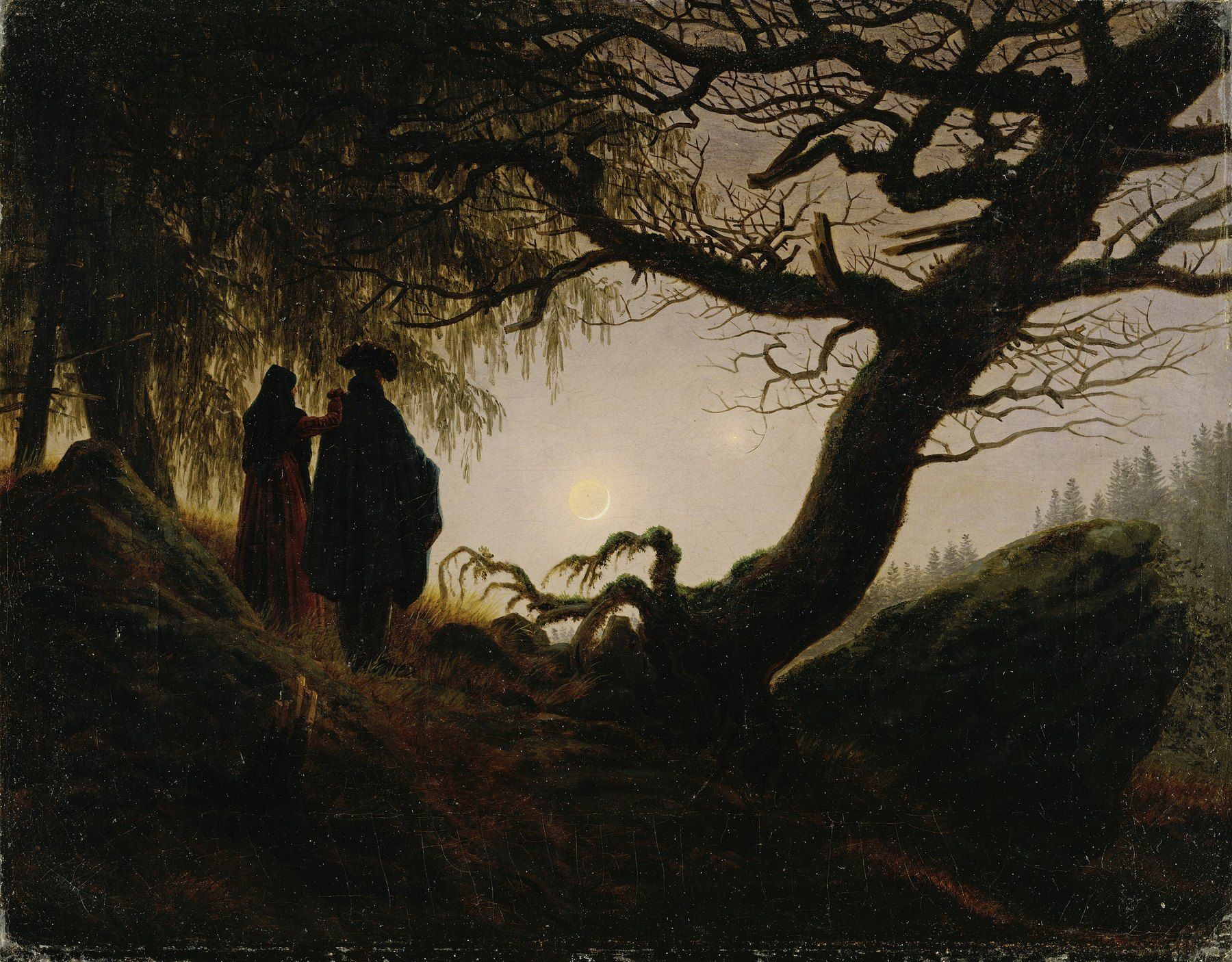
The figure of this love is still a triangle, but an open one, and Caspar David Friedrich painted it without meaning to: a man and a woman standing side by side with their backs to us, her hand on his shoulder, both of them looking out at the same moon. The third point is still there, as it must be, since two people with nothing outside themselves would soon have nothing to say to each other, but it no longer stands between them as an obstacle; it stands ahead of them as a world, a house or a child, a work or a city, a conversation that has not finished, and the lines that once ran from each of them to an obstacle that kept them apart now run side by side toward something they face together.
This is the love that the choice between eros and agape leaves out, a choice the Swedish theologian Anders Nygren made famous in the 1930s when he set the two against each other as the acquisitive love that seeks its own good and the self-giving love that seeks nothing, and the geometry of agape is a center that radiates to every point on a circle, the same light falling on all of them and needing nothing back, which is also the shape of the bodhisattva’s 慈悲. Such love is admirable, but it is not the love of two people, which wants to be returned and recognized and would be wounded rather than ennobled if it were not; nor is it the hungry love of the triangle, which needs the other’s absence to go on wanting them. The open triangle stands between the two, a love that needs a return but does not need a lack.
We can now answer the questions with which we began, and to the first, whether desire is a perversion of love, the answer is no, for Socrates himself conceded that to desire what one has is to want it present in the future, and so desire is love in the future tense, leaning toward what is not yet, as delight is love in the present tense, resting in what is. What dies when the beloved is won is the desire that lived on the obstacle, and if nothing else was there, love dies with it, as the old wisdom says; but where the two have a world to face, desire does not die, it changes its object, from the beloved’s absence to the beloved’s continuing presence, which is no longer a hunger for what is missing but a care for a shared tomorrow. Desire turns perverse only when the lover prefers the gap to the person, and the cure for it is not to want less but to want the other’s good rather than one’s own wanting, which is close to what I have elsewhere called letting-be, the love that says to the beloved, I want you to be.
Sappho’s line about the limb-loosener turns on two small words, “once again”, and Carson hears in them the whole temporal trouble of eros, which strikes the lover again and again and is, as she says, “quite new every time.” In the triangle that return is a torment, the same wound reopened by the same absence, but in a love that has a world to face it can be a gift, desire coming back not because something is missing but because someone is there, while the moment in which it first arrived, which no clock could measure, goes on sounding through the years the two share, love’s past tense, which never quite becomes the past. In that return Sappho’s order is restored, the sweet arriving first, and the bitter, when it comes, is no longer the taste of a lack but of the risk that every lover runs, the knowledge that what we love can be lost and that its loss would echo too, which is part of what makes it sweet.
Plato is quoted in the translations of W. R. M. Lamb (Symposium, with two phrases from Benjamin Jowett) and H. N. Fowler (Phaedrus), Aristotle in W. D. Ross’s, Pliny in John Bostock and H. T. Riley’s, and Sappho in Anne Carson’s, from Eros the Bittersweet. The paintings are in the public domain; the photograph of Canova’s sculpture is released into the public domain (CC0), and that of the Pompeii fresco is by Richard Mortel (CC BY 2.0). The recordings of Satie, by Robin Alciatore and La Pianista, are in the public domain, and Thérèse Dussaut’s recording of the Pavane, made by Glenn White in 1976, is shared under CC BY-SA 2.0.