Tagged
Research
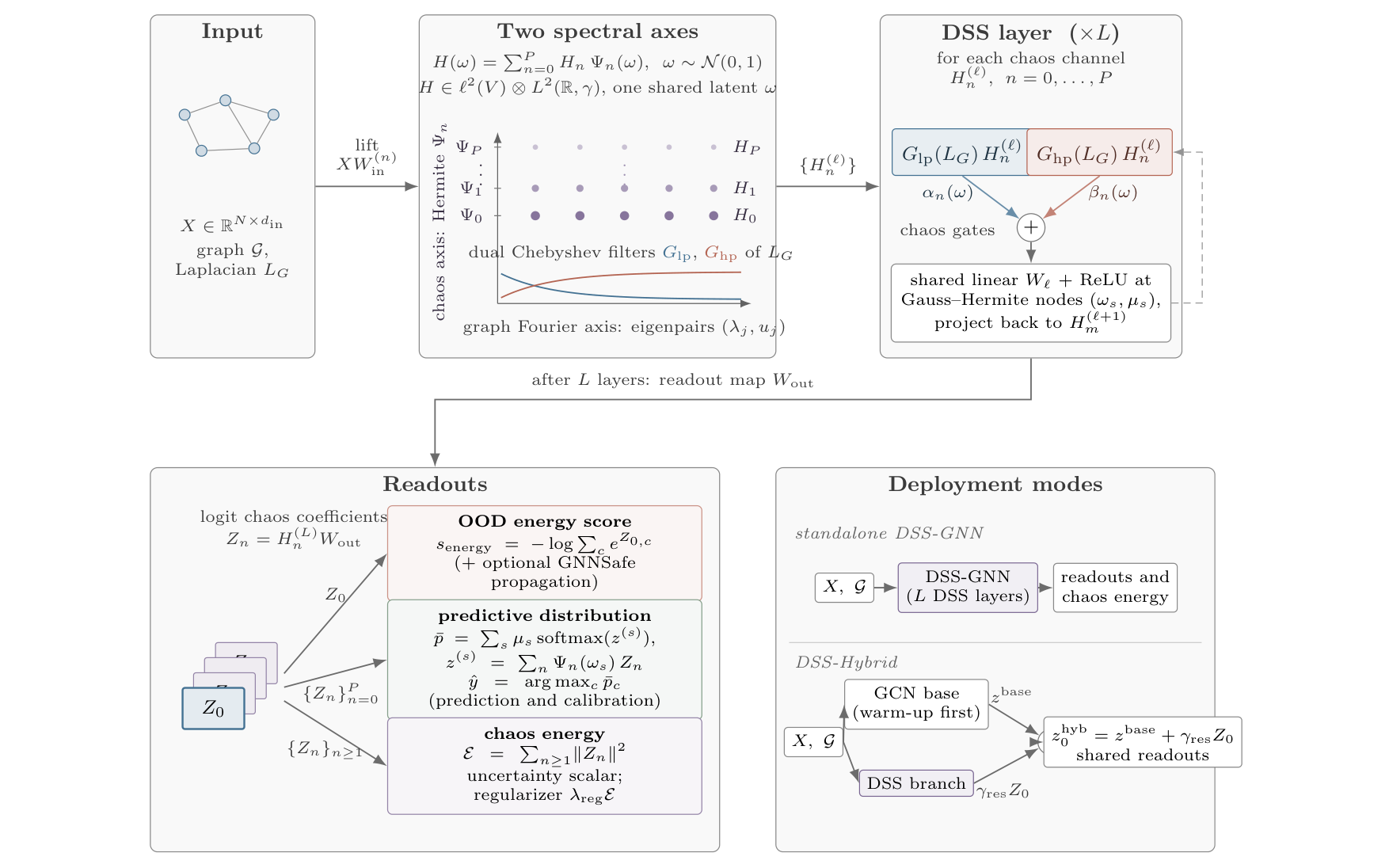
A Unified Uncertainty Representation for Graph Neural NetworksDSS-GNN stores each node's embedding as a short polynomial chaos expansion in one shared Gaussian variable and filters it along two spectral axes, graph frequency and chaos order. Readouts of this one representation, computed in a single deterministic pass, give calibrated predictions, OOD scores and robustness to distribution shift.
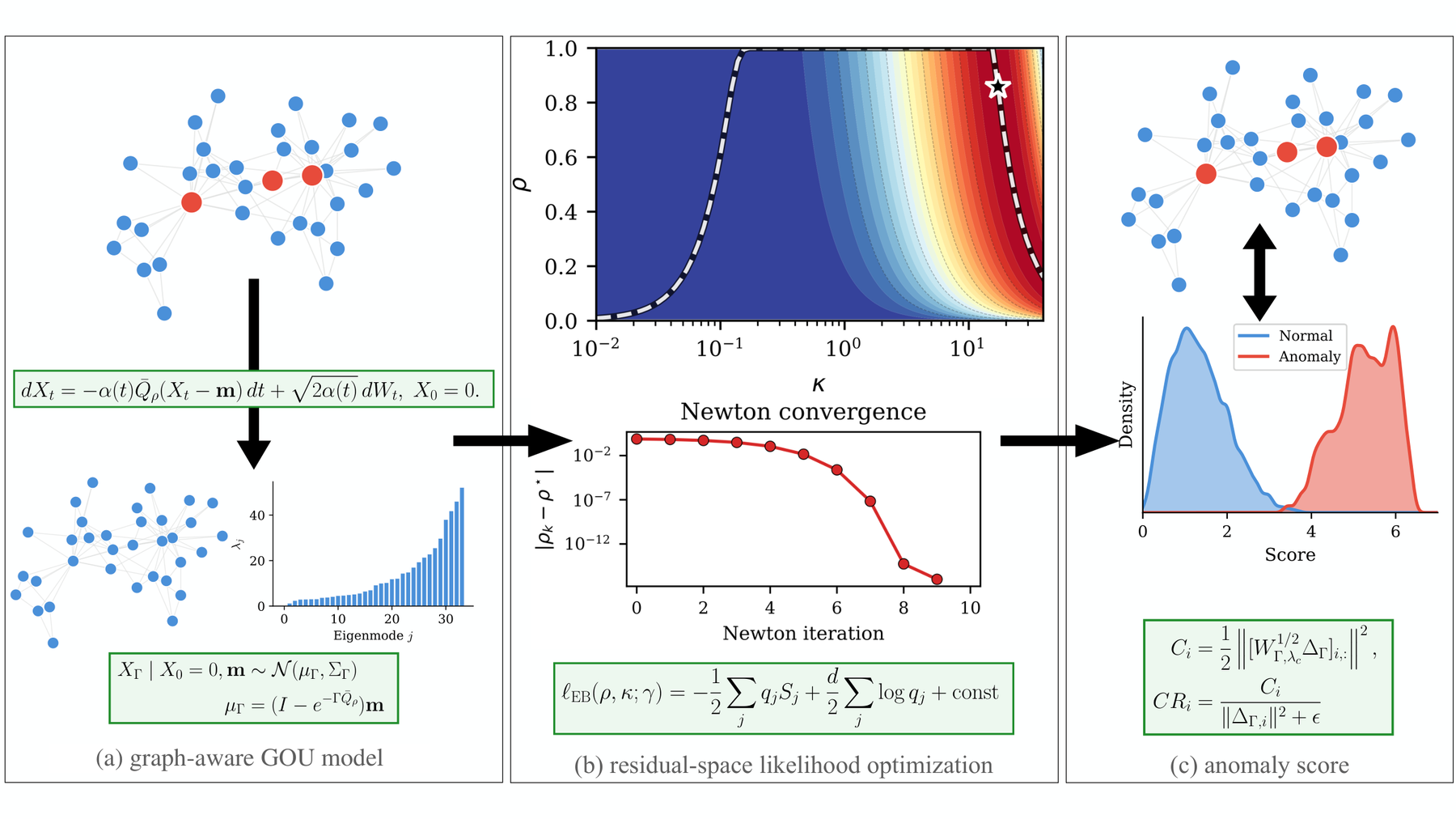
 Graph Anomaly Detection as Finite-Horizon ControlEB-GAD scores graph anomalies with no labels and no training: empirical Bayes fits a graph-aware Gaussian model of normal in closed form, and each node is scored by the finite-horizon control energy needed to steer a neutral start to it under a graph Ornstein–Uhlenbeck process. Best or tied-best AUROC on 9 of 11 benchmarks.
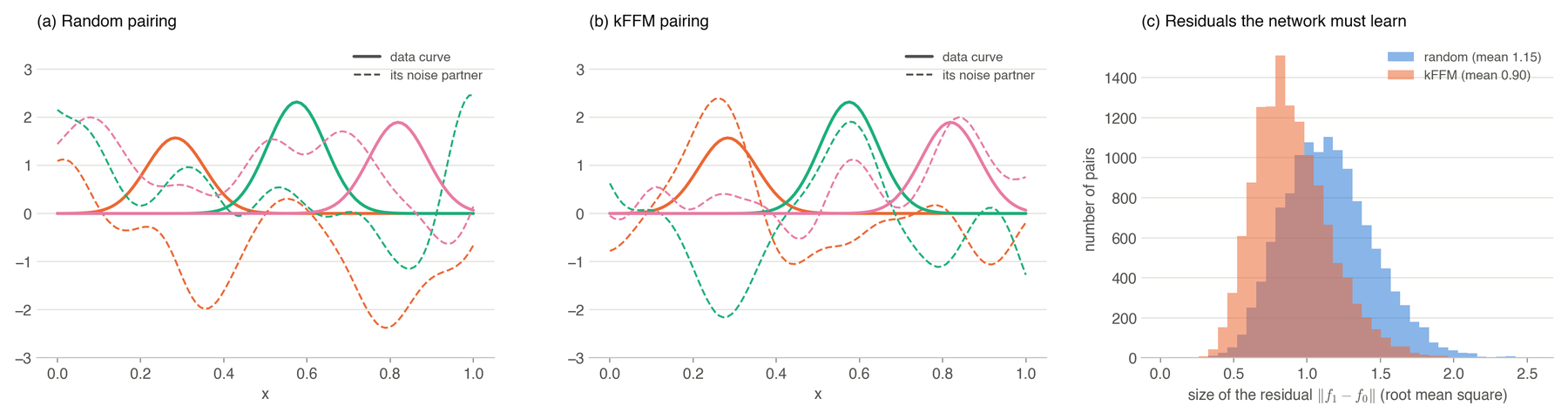
 Improving Function Space Flow Matching with Kernel Optimal TransportkFFM replaces the random noise–data pairing of Functional Flow Matching with entropic optimal transport under a kernel-induced cost, the coupling behind the Hilbert Sinkhorn Divergence: a signature kernel for paths, a Sobolev or Euclidean RBF for fields. Same network, same loss, 5–7% more training time, and better samples on eight time-series and PDE benchmarks.
Graph Anomaly Detection as Finite-Horizon ControlEB-GAD scores graph anomalies with no labels and no training: empirical Bayes fits a graph-aware Gaussian model of normal in closed form, and each node is scored by the finite-horizon control energy needed to steer a neutral start to it under a graph Ornstein–Uhlenbeck process. Best or tied-best AUROC on 9 of 11 benchmarks.
Improving Function Space Flow Matching with Kernel Optimal TransportkFFM replaces the random noise–data pairing of Functional Flow Matching with entropic optimal transport under a kernel-induced cost, the coupling behind the Hilbert Sinkhorn Divergence: a signature kernel for paths, a Sobolev or Euclidean RBF for fields. Same network, same loss, 5–7% more training time, and better samples on eight time-series and PDE benchmarks.